What Do “Lean Muscle, Lots of Water, and Early to Bed” Actually Improve? An Evidence Report on Health Slogans, Energy Deficiency, and Women’s Menstrual Health
Hydration, sleep and activity each matter. A universal body-fat target, water quota or bedtime cannot replace assessment of menstrual changes and energy needs.

In this article
Research update: 2026-11-01 | Nature of this article: a narrative evidence review of publicly available research and guidelines, not a systematic review or an individual diagnosis. The original research draft remains unchanged.
“Lean muscle,” “lots of water,” and “early to bed” refer to physique, drinking water, and sleep. They all sound like straightforward health advice. What really needs investigation is not which slogan is more popular, but which behaviors remain supported by evidence when those slogans turn into numerical targets that must be met, and which risks have already gone beyond what the research can support.
This article separates the evidence into three levels: platform slogans are observations about communication; advice on drinking water and sleep comes from population guidelines; and, for dieting, exercise, and menstrual disturbances, priority is given to randomized trials and endocrine guidelines. For the original draft’s claims of “billions of views,” the obesity percentage in a particular sleep white paper, and a universal body-fat warning threshold for women, we could not find original definitions and methods sufficient for verification. They are therefore not used as facts or chart data in this article.
1. Framing the question: three behaviors, three entirely different kinds of evidence
There is merit in “replacing sugary drinks with plain water,” “making room for sleep in your schedule,” and “focusing on strength and function when exercising.” But “everyone must drink two liters every day,” “you must go to sleep before a particular time,” and “you only have lean muscle once body fat falls to a particular number” all mistake population advice for individual pass marks. The scale of a trend requires verifiable dates, labels, and counting rules supplied by the platform. Without those data, we can discuss this way of expressing an idea and its potential consequences, but cannot report precise popularity figures.
| Question | Evidence that can currently be cited | What it can tell us | What it cannot establish |
|---|---|---|---|
| “Lots of water” | Daily drinking-water references in the Dietary Guidelines for Chinese Residents; a multinational study of water turnover[1] | Needs should be adjusted for activity, environment, and physical condition | Everyone must finish the same water bottle; more is always better |
| “Early to bed” | AASM/SRS consensus on adult sleep duration[2] | Most adults should aim for regular and sufficient sleep | Everyone must be asleep at 22:00; sleep can compensate for insufficient energy intake |
| “Lean muscle” | FHA guidelines, the IOC REDs consensus, and the REFUEL randomized trial[3–6] | Chronically inadequate energy intake can harm reproductive and bone health | A single body-fat percentage can diagnose or rule out risk |
The table also points to a gap in study design: this review of the materials did not identify a randomized clinical trial testing “lean muscle, lots of water, and early to bed” as a complete program. This was not a systematic search, so it cannot prove that no such research exists. The discussion below addresses measurable behaviors and outcomes within these ideas; the result of one study cannot be extrapolated directly to the whole trend.
Chorsu Bazaar, Tashkent, Uzbekistan | Reference illustration; photography: Advantour
2. Drinking water: 1,500 milliliters is a reference, not a competition
The Dietary Guidelines for Chinese Residents (2022) give a suitable drinking-water reference of approximately 1,500 milliliters/day for the general adult female population in a temperate environment with low physical activity. This refers to drinking water, rather than the total water contained in all foods and beverages. Needs change with temperature, activity, and illness. An isotope study of water turnover involving 5,604 people in 23 countries found associations with age, body size and composition, physical activity, pregnancy, temperature, humidity, and other factors[1]. Water turnover itself is not the amount of plain water each person should drink, because food and metabolism within the body also supply water.
People who can replace sugary drinks can spread their water intake through the day according to thirst, meals, and exercise; there is no need to race through the markings on a water bottle. Drinking a large amount in a short time can cause hyponatremia, particularly when fluid intake after endurance exercise exceeds sweat losses and electrolyte replacement is overlooked. If headache, nausea, confusion, or similar symptoms develop, do not continue forcing yourself to drink; seek medical attention. People with heart or kidney disease, or who need to restrict fluids, should follow their own treatment plans. Urine color alone also cannot diagnose everyone’s hydration status.
Historic architecture in Shakhrisabz, Uzbekistan | Reference illustration; photography: Advantour
3. Sleep: research supports enough sleep, not a universal “ten o’clock deadline”
The joint adult consensus from the American Academy of Sleep Medicine and the Sleep Research Society recommends that adults should regularly sleep at least 7 hours per night to support health[2]. This is a population-level recommendation about duration. It does not require everyone to lie down at a particular time, nor does it mean looking only at total hours while overlooking insomnia, sleep apnea, shift work, or life stress. The original draft’s “46.2% in a 2026 white paper” lacked accessible sampling methods and original tables and has therefore not been retained.
For someone who has long gone to sleep in the early hours, gradually making wake-up time, light exposure, and bedtime more consistent is usually more workable than suddenly imposing lights-out at 22:00. Observational studies associate insufficient sleep with abnormalities in weight, mood, and metabolism. Those associations, however, do not establish that a particular bedtime can prevent amenorrhea, and they cannot replace attention to excessive training or food restriction.
4. The main concern is a persistent energy deficit, rather than “thinness” itself
Energy availability is the energy remaining after exercise expenditure is subtracted from intake, expressed relative to fat-free mass. Prolonged inadequacy may alter metabolic signals associated with reproductive function and the hypothalamic–pituitary–ovarian axis, affecting ovulation and menstruation. Leptin, thyroid-axis signals, and stress-related signals are involved. These are interacting pathways, not a single switch that can be described as “body fat reaches 17%, leptin drops, and menstruation must stop.”
A metro station in Tashkent, Uzbekistan | Reference illustration; photography: Advantour
The original draft treated 17% body fat and 30 kcal/kg fat-free mass/day as diagnostic cutoffs for all women. Research does not support that use: body-fat measurements have errors, and experimental thresholds for energy availability are also influenced by the measurement method, duration of exposure, and individual factors. The exercising women in the REFUEL randomized trial already had menstrual disturbances, yet their reported mean baseline body fat was 24.7% ± 0.6%[5]. This does not mean “24.7% is necessarily dangerous,” but it does show that a single body-fat cutoff cannot rule out a problem. The IOC’s 2023 REDs consensus uses a clinical risk assessment involving multiple indicators, rather than weight or body fat alone[4].
Functional hypothalamic amenorrhea (FHA) is often associated with inadequate energy, exercise, psychological stress, or some combination of them, but it is a diagnosis of exclusion[3]. People whose weight has not noticeably fallen may also be affected when training increases or intake is insufficient; not everyone who loses weight develops amenorrhea. This article has no evidence supporting a statement such as “losing 10%–15% of body weight almost inevitably causes amenorrhea.”
5. What randomized trials tell us—and what they do not
The REFUEL study randomized 76 exercising women who already had oligomenorrhea or amenorrhea to increased dietary energy intake (40 participants) or maintenance of their previous intake (36 participants), with 12 months of follow-up. The increased-intake group consumed an average of approximately 330 ± 65 additional kilocalories/day. In the intention-to-treat analysis including all randomized participants, the hazard ratio (HR) for experiencing menses during the intervention was 1.91 (95% CI 1.27–2.89)[5]. An HR is not an absolute probability of an event. This was an intervention result in a particular population, not a prescription telling women in general how much extra to eat each day.
Ancient stone figures at the Burana Tower site, Kyrgyzstan | Reference illustration; photography: Advantour
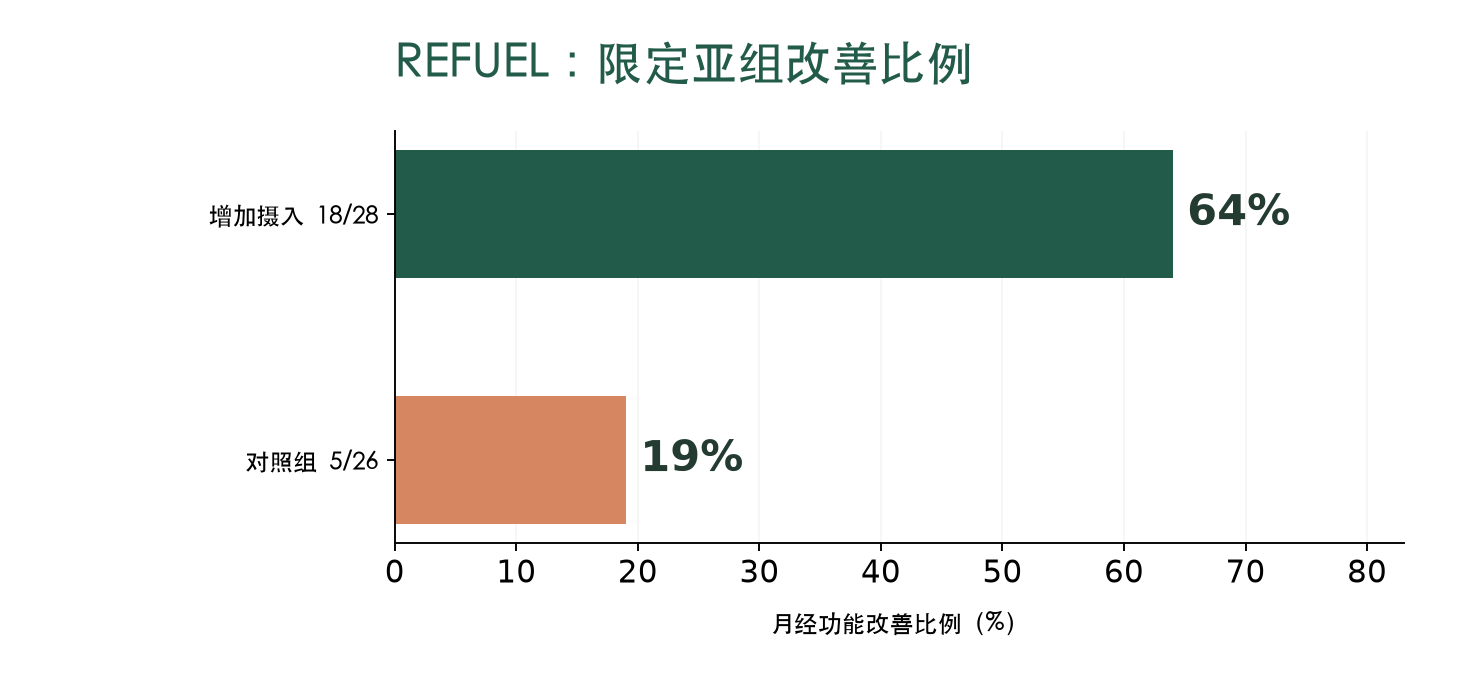
Figure 1 | After the investigators further excluded 22 participants with unclear baseline cycles or insufficient follow-up, improvement in menstrual function was observed in a restricted subgroup: 18/28 (64%) in the increased-intake group versus 5/26 (19%) in the control group. The 64% figure cannot be described as a cure rate among all 76 participants, nor can it establish that women who do not exercise would receive the same benefit[5].
Bone outcomes require a separate accounting. REFUEL’s bone-density analysis showed that, although menses were more likely to occur in the increased-intake group, bone mineral density did not improve relative to the control group over 12 months[6]. For the time effect across both groups combined, the study reported that femoral-neck bone mineral density was approximately 0.006 g/cm² below baseline at month 6 and 0.011 g/cm² below baseline at month 12. These were not differences between the two groups, and certainly cannot be used to claim that additional energy harms bone.
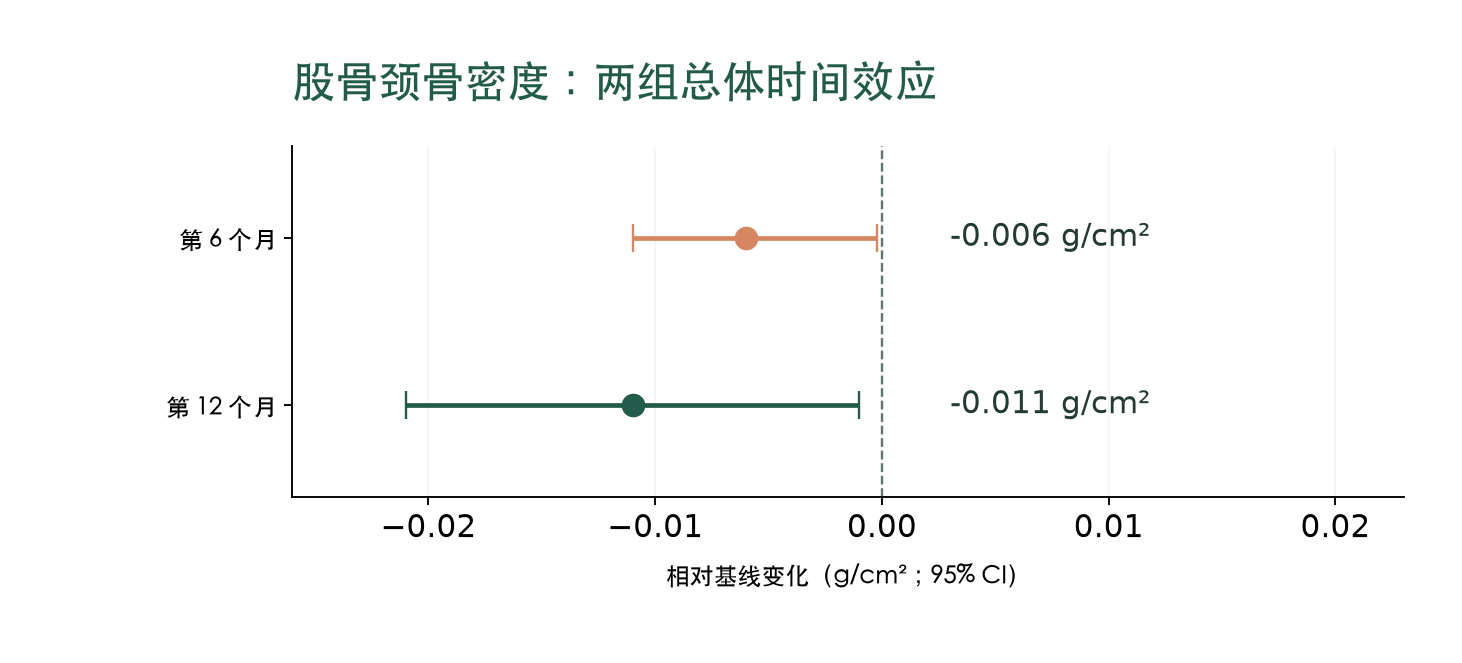
Figure 2 | Overall time effect on femoral-neck bone mineral density relative to baseline. Points and horizontal lines show estimates and 95% confidence intervals: −0.006 (−0.011 to −0.0002) g/cm² at month 6 and −0.011 (−0.021 to −0.001) g/cm² at month 12[6]. These were changes observed during follow-up, not treatment effects comparing increased intake with the control group.
6. Less frequent periods, hair loss, and fatigue: avoiding self-diagnosis
If periods remain infrequent or stop, clinical assessment first needs to exclude pregnancy, then consider food restriction, exercise load, psychological stress, and recent weight changes in the context of the medical history. Thyroid dysfunction, hyperprolactinemia, PCOS, premature ovarian insufficiency (POI), and perimenopausal changes can all present with menstrual abnormalities. A body-fat scale or a single hormone test cannot diagnose FHA on its own. Arrange a gynecological or endocrine assessment for absence of menstruation exceeding 3 months, or a longer interval without a period in someone whose cycles were already irregular. Whether bone-density testing is needed and which hormones to test depend on age, duration, fracture history, and the clinician’s judgment[3].
Iskanderkul Lake, Tajikistan | Reference illustration; photography: Advantour
Hair loss may also be associated with rapid weight loss, iron deficiency, thyroid disease, postpartum changes, medications, or common female-pattern hair loss. Telogen effluvium often appears months after the trigger. “Hair loss and amenorrhea occurring together” warrants medical attention, but does not mean the same mechanism necessarily causes both. The original draft attributed hair loss mainly to low body fat and low estrogen, an interpretation with evidence boundaries too narrow to serve as a differential diagnosis.
For patients with diagnosed FHA, guidelines recommend improving energy balance as the foundation, adjusting exercise and increasing intake when needed, alongside nutritional and psychological support[3]. Withdrawal bleeding caused by hormonal contraceptives does not demonstrate that the hypothalamic–ovarian axis has recovered. Whether other hormone regimens should be used to manage continuing bone-health risks needs discussion with a clinician after a complete assessment; medication should not be self-prescribed.
7. Observations on communication and products: do not turn healthy behavior into an examination
Large water bottles, early-bedtime check-ins, and body-fat scales can make abstract goals visible. They can also create the illusion that “you are only disciplined if you drink enough, and only healthy if you reach a certain degree of thinness.” This is an inference about communication mechanisms, not a market size measured in this article. The original draft mentioned particular trending searches, prices, and sales figures without verifiable dates, platform query conditions, or original data, so those numbers are not repeated here.

A mosque in Ashgabat, Turkmenistan | Reference illustration; photography: Advantour
Further study of this trend should, at a minimum, record platform search terms, reporting periods, deduplication rules, and the distinction between video plays and unique viewers. Medical research should record dietary intake, exercise load, menstrual diaries, and clinical outcomes, comparing populations of different ages and with different pre-existing conditions. Until such information is available, it is inappropriate to claim “how much amenorrhea or hair loss the trend has caused.”
8. Practical conclusions: adjust for bodily signals and clinical context
First, plain water can be an everyday drink, but there is no need to chase the capacity of a particular bottle; activity and illness change requirements. Second, try to make room for regular and sufficient sleep, without treating a particular bedtime as a universal assessment criterion. Third, exercise should aim at strength, function, and sustainability. If food restriction, menstrual changes, recurrent injuries, or fatigue occur alongside it, have energy status assessed early rather than looking only at body-fat percentage.
What this review can support is that “extreme health check-ins may obscure risks” and that “correcting an energy deficit has clinical-trial support for exercise-related menstrual problems.” It cannot support a uniform prescription for everyone’s water intake, bedtime, body-fat percentage, or additional calories. Taking menstrual and sleep records, changes in exercise and diet, your medical history, and current medications to discuss with a clinician is more likely to bring you closer to the problem itself than pursuing three slogans.
Evidence sources and research boundaries
- Yamada Y, et al. Variation in human water turnover associated with environmental and lifestyle factors. Science. 2022. DOI: 10.1126/science.abm8668. Observational study of 5,604 people in 23 countries; measures water turnover rather than prescribing water intake.
- Watson NF, et al. Recommended Amount of Sleep for a Healthy Adult: A Joint Consensus Statement of the AASM and SRS. J Clin Sleep Med. 2015. DOI: 10.5664/jcsm.4758. Expert consensus on adult sleep duration.
- Gordon CM, et al. Functional Hypothalamic Amenorrhea: An Endocrine Society Clinical Practice Guideline. J Clin Endocrinol Metab. 2017. DOI: 10.1210/jc.2017-00131. FHA is a diagnosis of exclusion.
- Mountjoy M, et al. 2023 IOC consensus statement on Relative Energy Deficiency in Sport (REDs). Br J Sports Med. 2023. DOI: 10.1136/bjsports-2023-106994. Risk assessment in exercising populations, not a diagnostic body-fat standard for women in general.
- De Souza MJ, et al. Randomised controlled trial of increased energy intake on menstrual recovery in exercising women: REFUEL. Hum Reprod. 2021. DOI: 10.1093/humrep/deab149. Intention-to-treat and restricted-subgroup results must not be conflated.
- De Souza MJ, et al. Bone mineral density in response to increased energy intake: REFUEL. Am J Clin Nutr. 2022. DOI: 10.1093/ajcn/nqac044. The 12-month bone-density outcome did not demonstrate a benefit of the intervention.
- Chinese Nutrition Society: the adequate-water-intake recommendation in the Dietary Guidelines for Chinese Residents (2022). The general reference of 1,500 mL/day for women cited here is drinking-water guidance for temperate conditions and low activity, not a compulsory individual minimum.
Methods and limitations: Searchable guidelines, consensus statements, and original trials were consulted according to the original draft’s topics, with abstracts and accessible full texts checked. No systematic search, risk-of-bias assessment, or pooled effect estimation was performed. The Central Asian photographs throughout are visual reference material, not images of research sites or participants. This article is for the exchange of health information only and does not replace diagnosis or treatment.
Read the source material
- Water turnover, environment and lifestyle study
- AASM/SRS: Adult sleep duration consensus
- Endocrine Society: Functional hypothalamic amenorrhea guideline
- IOC: Relative Energy Deficiency in Sport consensus
- REFUEL: Energy intake and menstrual recovery trial
- REFUEL: Bone mineral density outcomes
The original archive manuscript is restored above. These additional references offer context; their inclusion does not constitute medical validation of every original claim. Clinical and regional terminology review are pending.
A good question starts a conversation.
Explore a related editorial discussion. Reading is open to everyone; posting and replying require a free reader account.
More from the library
 Nutrition & evidence · 13 MIN READSoy, Isoflavones, and Equol: Can That Bowl of Soy Foods Really “Replenish Estrogen” After 40?↗
 Nutrition & evidence · 11 MIN READAvoiding the Supplement Sales Trap: An Evidence-Based Buying Guide for Women Over 40↗
 Nutrition & evidence · 12 MIN READCan Inositol Help with PCOS and Menstrual Cycles?↗