Seed Cycling: Good Food, but What Is the Evidence for Hormonal Balance?
Seeds can be part of a varied diet. Their nutritional value is a separate question from whether rotating them by menstrual phase works.
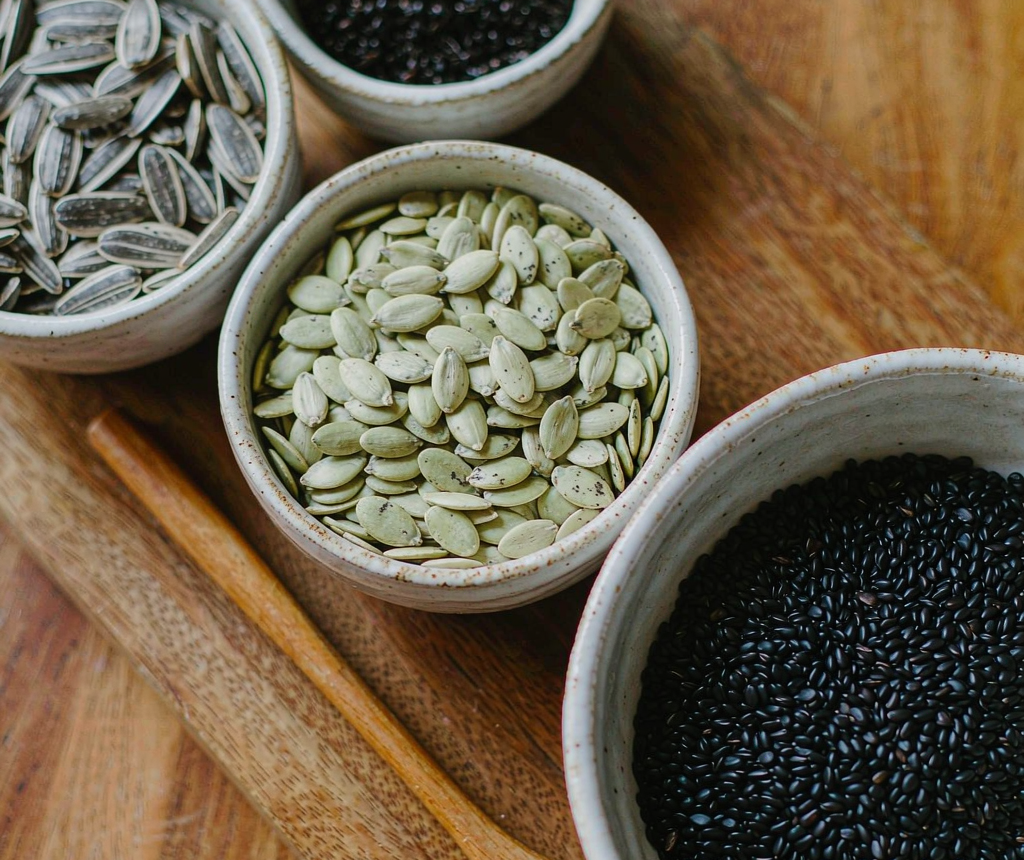
In this article
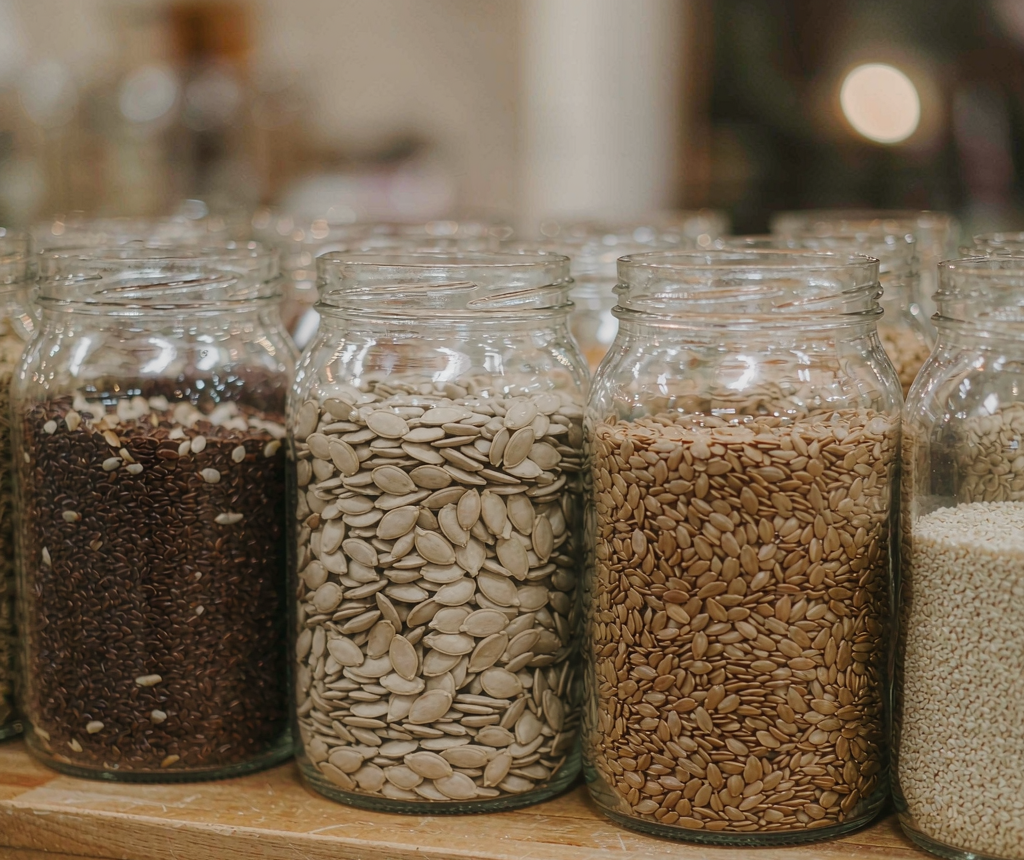
On the shelf they are simply food; only after being assigned a "hormone-regulating" function do they become a claim that needs testing
1. Thirty Seconds at the Supermarket Shelf
A weekend supermarket, by the grain shelves. A woman in her forties holds a bag of flaxseed in her left hand while scrolling through her phone with her right. A friend of a similar age stands beside her.
"Let me check... Start flaxseed and pumpkin seeds on the first day of your period, then switch to sesame and sunflower seeds after day fourteen." She turns the bag over to inspect its ingredients. "Apparently you can eat your way to hormonal balance."
Her friend asks, "Does it work?"
"It probably helps a bit. They're all good foods, and there's no harm." She puts both bags in the cart. "You have nothing to lose by eating them."
"You have nothing to lose by eating them."
This article takes that sentence seriously. It sounds like the least confrontational part of the conversation, yet it is also what makes the claim hardest to question: when a method is widely considered harmless, it is rarely examined seriously.
Seed cycling is one such topic. It is not as extreme as drinking only a particular juice each day, as extravagant as "detox" claims, or as visibly pharmacologically risky as some supplements. It appears to mean simply eating some seeds and changing them according to a schedule.
That is precisely why it deserves a closer look.
2. What Exactly Does the Claim Propose?
2.1 The Practical Version
Most circulating versions divide the menstrual cycle into two parts and rotate specific seeds accordingly.
Follicular phase
From menstrual day 1 to ovulation, approximately day 14: flaxseed plus pumpkin seeds, supposedly to "support estrogen metabolism."
Luteal phase
From after ovulation to the next period: sesame plus sunflower seeds, supposedly to "support progesterone production."
The usual recommendation is one to two tablespoons daily, ground and stirred into yogurt, oats, or salads, or made into breakfast bowls and energy balls. This format is important: it determines how efficiently the claim spreads.
Four colors of seeds do look attractive; beautiful plating and sufficient clinical evidence are different things
2.2 Why Does It Spread So Well?
First, it is exceptionally photogenic. Four colors of seeds arranged on yogurt make an attractive photograph, giving this content a natural advantage on image-driven platforms. By contrast, however sound the advice, "complete 150 minutes of moderate-intensity exercise weekly" does not produce such a pretty picture.
Second, the barrier is extremely low. Ingredients are available in supermarkets. No prescription, equipment, appointment, or restructuring of daily life is required. Just put two more bags in the cart.
Third, it carries the meaning of "I am actively managing my body." Stirring a spoonful of seeds according to the cycle is concrete and ritualistic, providing a sense of control. This psychological benefit is real and helps explain the practice's persistence.
Fourth, and most importantly, there is no obvious foothold for challenging it. It appears too gentle. Arguing over adverse effects is difficult: seeds are food, after all. Questioning it is costly, while sharing it is easy.
A typical "low-intensity but persistent" topic
It will not spread explosively and then disappear after debunking like an extreme detox, nor is it likely to disappear altogether. It remains like background noise: accessible, ordinary ingredients, visually friendly, and apparently low-risk. The public value of discussing these topics is often underestimated.
2.3 The Mechanisms It Invokes
Its proposed mechanisms are not entirely invented. They cite several real biochemical facts.
Flaxseed: it contains lignans, which gut microbes can convert into substances with weak estrogenic activity, such as enterolactone and enterodiol. This has been studied and is the origin of claims that flaxseed affects hormone metabolism.
Pumpkin seeds and sesame: they contain nutrients including zinc, selenium, vitamin E, and unsaturated fatty acids. Zinc and selenium participate in multiple enzyme systems and antioxidant processes. This is genuine nutritional information.
Sunflower seeds: rich in vitamin E and linoleic acid.
So if the question is simply whether these seeds contain compounds related to hormones, the answer is yes.
But the central issue in this article comes after that "but."
3. Evidence Review: The Gap Between "Contains a Compound" and "Cycling Seeds Works"
3.1 The First Gap: Amounts and Bioavailability
"A food contains an active compound" and "eating it significantly changes hormone levels" are claims of very different strength.
Frequently omitted steps include the actual concentration in the food, losses during processing and storage—flaxseed lignans are relatively sensitive to light, heat, and oxidation, with deterioration easier after grinding—digestion and absorption, and metabolic conversion differences arising from individual gut microbiomes.
For example, converting lignans into weakly estrogenic enterolactone depends on particular gut microbes. Microbiome composition differs substantially between people: the same flaxseed intake may therefore produce very different metabolite levels. Viral content almost never mentions such individual variation because it complicates the clean story of "works for everyone."
3.2 The Second Gap: Most Studies Do Not Investigate "Cycling"
Most flaxseed and lignan studies examine flaxseed intake itself, such as effects on blood lipids, particular hormone measures, or breast-health biomarkers. A substantial proportion are observational studies or small interventions.
Remember: observational studies identify associations, not direct causation. People who regularly eat flaxseed often have other healthy behaviors—better overall diets, more exercise, and less smoking—making confounding difficult to eliminate fully.
The more important point is that human clinical evidence is currently lacking for the specific practice of rotating particular seeds across two menstrual phases.
To avoid misunderstanding, this does not mean seeds are harmful or lack nutrition. It means that this overall protocol—which seeds, at which times, rotated to achieve hormonal balance—has not received human clinical validation proportionate to its popularity.
The circulating version: "Research proves seed cycling balances hormones."
A more accurate statement is that seeds contain compounds relevant to hormone metabolism, and those compounds have been studied, but
the specific practice of "rotating them by cycle phase" lacks supporting human clinical evidence.
"Contains relevant compounds" and "this protocol achieves this goal" occupy entirely different evidential levels.
3.3 The Third Gap: If Someone Improves, Where Might the Effect Come From?
Suppose someone feels better after three months. Several explanations do not require seed cycling to have altered hormones.
Reason one: improved overall diet quality. This is the most likely explanation. People starting seeds often simultaneously pay more attention to food, reduce processed foods, and eat breakfast more regularly. The fiber, quality fats, and micronutrients in seeds are genuinely beneficial. But these benefits arise from overall dietary improvement rather than the specific rotation rule.
Reason two: natural symptom fluctuation. Many cycle-related symptoms fluctuate. Starting an intervention when symptoms are severe naturally makes subsequent improvement more likely. This is regression to the mean, independent of the intervention.
Reason three: psychological effects of behavior. A daily self-care ritual may improve subjective experience. The effect is real, but comes from behavior and expectations rather than seeds.
Reason four: other simultaneous changes. Examples include a new job, starting exercise, improved sleep, or stopping something that affected the cycle.
This is the classic challenge of causal inference.
When a claim comes from many personal experiences, and those people made many simultaneous changes, attributing the benefit to one action is the step most likely to be mistaken.
This does not mean they are wrong about feeling better. "I did A and then improved" simply does not equal "A made me improve."
3.4 Professional Criticism Centers on Two Points
Criticism one: treating food as a precise hormone-adjusting tool oversimplifies nutritional science.
Nutrition's central finding has never been that one food maps onto one physiological function. Foods provide interacting combinations of nutrients whose direction and magnitude of effects depend on overall diet, metabolic status, microbiota, activity, sleep, and many other factors.
"Eat these two in the follicular phase, switch to those two in the luteal phase, and balance estrogen and progesterone" implies that food timing and selection can control hormone levels like adjusting a dial. Modern nutrition does not support that precision. Hormonal regulation is a complex dynamic process involving the hypothalamic–pituitary–ovarian axis, adipose tissue, liver metabolism, and microbiota. Switching seeds cannot simply turn it to a chosen setting.
Criticism two: it can delay care for symptoms requiring diagnosis and treatment.
This matters more because it has practical health costs.
Imagine a woman whose periods have stopped for four months. She begins seed cycling, believing she is "restoring her body," and waits another six months before seeking care. The actual problem may be an endocrine abnormality requiring timely management, a perimenopausal transition requiring assessment, or another condition needing investigation.
Those six months are waiting, not treatment. Waiting can have costs.
Seed cycling's most underestimated risk
The risk lies not in the seeds themselves but in their potential to replace medical care. When amenorrhea, abnormal bleeding, or serious cycle disturbance provides a clear indication for consultation, "try seeds for a while first" costs time. Its sole apparent advantage, harmlessness, is precisely why it is selected.
4. Risks and Controversy: Why "Harmless" Deserves the Most Scrutiny
4.1 The Judgment of "Harmlessness" Has Usually Not Been Examined
Those saying "seeds cannot hurt" have usually not examined quantities, combinations, or circumstances in which they may be unsuitable.
Any food can require caution in certain contexts. For example:
· Flaxseed contains fiber and particular compounds; large amounts may cause digestive discomfort;
· Sesame is a common allergen, yet is repeatedly recommended in most seed lists;
· Nuts and seeds are energy-dense. Adding them to an unchanged diet increases total energy intake, relevant to metabolic or weight-management needs;
· People receiving certain treatments or taking medicines affecting clotting should consult a doctor before substantial intake of seeds rich in particular fatty acids;
· For thyroid-related conditions, large amounts of raw cruciferous vegetables and some seed foods are generally best discussed with a doctor.
This is not a claim that seeds are dangerous. Rather, "harmless" requires justification and cannot simply be assumed. When it becomes the default assumption, nobody examines it.
4.2 A More Important Question: What Is It Displacing?
Every "easy, harmless, sustainable" plan competes for something finite: the time, attention, and effort a person will invest in health.
If stirring in a spoonful of seeds replaces doing nothing, there is a net benefit: at least more fiber.
If it replaces investigating a menstrual disturbance, there is a net loss.
The substitution is often silent because the former is so much easier. This is why such topics deserve serious discussion: their gentleness makes the substitution seem natural.

Recording bodily responses is useful, but persistent abnormalities are what should be recorded and brought into a consultation
4.3 How Social Platforms Evaluate Content
Another structural reason for persistence is that sharing the claim carries almost no risk, while questioning it requires costly explanation.
Posting "I felt much better after eating seeds" is easy and safe. Explaining that "this practice lacks clinical evidence and may delay care" requires discussion of study design, evidence levels, and causality. However well written, it spreads less readily.
The result is a default bias toward gentle advice in public discussion of these topics. This is not a defect of one platform but a feature of information transmission. Understanding the structure has greater long-term value than memorizing one conclusion.
A useful judgment framework:
Be cautious when advice combines three features: (1) extremely low barriers and almost no cost; (2) highly specific promised outcomes such as "balance hormones" or "regulate cycles"; and (3) almost no visible population for whom it is unsuitable. The third matters particularly:
Effective medical interventions usually have defined indications and groups for whom they are inappropriate.
A plan that is "good for everyone, with no contraindications" is more likely under-researched than perfect.
5. Practical Suggestions: How to Eat, How to Judge, and When to Stop
5.1 About Eating the Seeds Themselves
If You Simply Want to Continue, Here Is an Approach
1. Treat them as food, not a treatment protocol. Seeds provide fiber, unsaturated fats, vitamin E, zinc, and selenium. Their value is real and needs no hormonal claim. As food, they provide nutrition; as a prescription, they provide expectations.
2. Do not fixate on rotation by cycle phase. There is no current evidence that switching seeds by phase is better than eating a small mixed portion daily. If you enjoy the ritual, that is harmless; if "having to follow the phase" causes stress, that stress has no corresponding health benefit.
3. Consider quantity and form. Grind flaxseed before eating because whole seeds are difficult to digest and absorb; store sealed and protected from light. If adding them to an unchanged diet, consider the effect on total energy intake.
4. Record observations without replacing consultations. Records that inform a doctor are useful. If tracking means "watching a little longer," check whether the observation period has already exceeded a reasonable wait.
5.2 A Signal Checklist: When to Stop Relying on Seeds and See a Doctor
Book a consultation for any of the following rather than continuing to watch
Cycle-related:
· Periods absent for more than 3 months after excluding pregnancy
· Cycles persistently shorter than 21 or longer than 35 days for more than 3 cycles
· Bleeding lasting more than 7 days or a sudden substantial increase in flow
· Bleeding between periods
· Any vaginal bleeding after menopause
Symptom-related:
· Pain interfering with work and daily life
· Hot flashes, night sweats, or mood changes clearly impairing quality of life
· Marked unexplained weight change
Fertility-related:
· No pregnancy after 12 months of trying, or 6 months over age 35
· A history of repeated early pregnancy loss
Set a time boundary beforehand: if you start seeds for a specific symptom, set a deadline, for example 4–8 weeks. If there is no improvement by then, seek care rather than extending observation. Set this in advance because people easily keep granting themselves extensions.
5.3 A Better Question
To evaluate "gentle health advice," replace "Can it hurt?" with:
"Does it have evidence, and what is it displacing for me?"
The first filters out ineffective methods. The second identifies those that, despite being harmless, displace more important actions within your limited time and attention.
For seed cycling, the first answer is "beneficial as food, lacking clinical evidence as a hormone-regulating protocol." The second is "it may use time that should go toward establishing the cause of symptoms."
Answer both, and your choice becomes much clearer.
5.4 A Particular Reminder for Readers Over 40
Perimenopause is a phase in which such ideas easily take up residence.
The reasons are clear: bodily sensations change, symptoms multiply, cycles become unpredictable, and many problems have no simple one-pill solution. Gentle, controllable daily actions are especially attractive in that setting.
Seed cycling adds the appeal of appearing to "work with the female cycle." That sense of fit makes it easy to believe it was designed for this life stage. But its framework assumes a regular cycle, whereas irregularity is a defining feature of perimenopause. The mismatch deserves recognition.
Actions truly valuable in perimenopause are usually less photogenic: recording symptom timing and frequency, assessing whether tests are needed, discussing whether to intervene, and considering specific options and risks with a doctor. They do not make attractive photographs, but they form the real foundation of care.
6. Conclusion: Harmless Does Not Mean Effective
Return to "you have nothing to lose" by the supermarket shelf.
If we mean only the seeds themselves, that is broadly true. Flaxseed, pumpkin seeds, sesame, and sunflower seeds are good foods, and adding them to a daily diet is generally reasonable.
But there is a flaw: it treats "eating seeds" and "solving a hormonal problem" as the same thing. Three gaps lie between them: from containing a compound to changing its bodily levels; from research on an ingredient to efficacy of the specific rotation protocol; and from feeling better to seeds causing that improvement.
This article therefore offers three points:
First, "harmless" does not equal "effective." The absence of obvious risk means an approach need not be urgently stopped, not that it deserves recommendation. Efficacy requires separate evidence, and the specific practice of cycling seeds currently lacks human clinical evidence.
Second, "good food" does not mean "medicine." Seeds' nutritional value is real, and routine dietary inclusion is entirely reasonable. Treating them as a precise hormonal prescription oversimplifies nutrition and exaggerates a single food's control over a complex endocrine system.
Third, and most importantly, the real risk is delayed care rather than seeds. When amenorrhea, cycle disturbance, or abnormal bleeding gives a clear indication for consultation, "try seeds first" carries a time cost. Its apparent harmlessness often prevents that cost from being counted.
You can keep the two bags in your cart. They are good food.
Remember this too: when your body signals a problem, the appropriate response is a consultation, not a different seed. This has higher priority.
The supermarket shelves will keep stocking seeds. Some signals have a limited window for action.
References and Further Reading
· For research on flaxseed lignans and their gut-microbial conversion to weakly estrogenic enterolactone and enterodiol, consult reviews of phytoestrogens and nutritional metabolism.
· Studies of flaxseed intake and hormonal or metabolic measures are mostly observational or small interventions. Observational findings indicate association, not direct causality.
· For the nutritional roles of fiber, unsaturated fats, zinc, selenium, and related nutrients, consult national dietary guidelines and nutrition textbooks.
· For indications and assessment pathways for menstrual disturbance, amenorrhea, and abnormal uterine bleeding, consult relevant obstetric and gynecological society guidelines.
The observational/interventional nature of cited research is indicated in the text. The lack of human clinical evidence for the specific seed-cycling practice is stated explicitly.
This article provides health education, not individualized medical advice. Foods and nutrients are described using ordinary ingredient and generic nutrient names, without recommending supplements or medicines. Consult qualified health professionals for dietary changes, symptom assessment, and treatment decisions. If receiving treatment, taking medicines affecting clotting, or living with allergies or thyroid-related conditions, check with your treating doctor before substantially increasing a particular seed. Observational studies indicate associations, not direct causality.
Read the source material
The original archive manuscript is restored above. These additional references offer context; their inclusion does not constitute medical validation of every original claim. Clinical and regional terminology review are pending.
A good question starts a conversation.
Explore a related editorial discussion. Reading is open to everyone; posting and replying require a free reader account.
More from the library
 Nutrition & evidence · 13 MIN READSoy, Isoflavones, and Equol: Can That Bowl of Soy Foods Really “Replenish Estrogen” After 40?↗
 Nutrition & evidence · 11 MIN READAvoiding the Supplement Sales Trap: An Evidence-Based Buying Guide for Women Over 40↗
 Nutrition & evidence · 12 MIN READCan Inositol Help with PCOS and Menstrual Cycles?↗