Women’s Exercise Injuries and Scientific Prevention: Runner’s Knee, Yoga Injuries, and Why Gentle Exercise Can Still Hurt
Knee pain has several possible causes, and flexibility is not stability. Let training, recovery and assessment guide the next step.

In this article
I. Starting with a reflection on “getting injured through exercise”
A scene from Bhutan: Punakha Dzong and its river valley
One weekend, several old classmates were chatting on a park bench when the conversation somehow moved from their children to their knees. One said she had followed the trend and run a half marathon early in the year, only to have pain on the outside of her right knee for two months; even going up and down stairs was difficult. Another added that she had practiced yoga for three years, but lately her lower back always felt tight in Wheel Pose, easing only when she stopped. They joked that they once believed “moving is always better than staying still.” Now they understood that exercising incorrectly could be worse than not exercising at all.
Reflections on “getting injured through exercise” have become especially common in fitness education on Douyin and Xiaohongshu in recent years. The most-saved posts are no longer “Get defined abs in seven days,” but “How I injured myself,” “Self-help for runner’s knee,” and “Avoiding yoga-related back injuries.” This change in content is itself a good thing: it means that more women are putting exercise quality ahead of exercise quantity.
But this shift can also go to the opposite extreme: some people give up exercise entirely after one injury, while others blame everything on “being too weak” or “having ugly form.” This article aims to explain runner’s knee and yoga injuries, two of the most frequent exercise injuries among women: how they develop, why they affect women more often, and how to protect yourself scientifically, so that you neither abandon exercise out of fear nor blindly push through pain.
The central message:
Most exercise injuries are not “accidents,” but are
predictable and preventable
—often arising from “increasing intensity too quickly,” “insufficient foundational strength,” and “wearing soreness as a badge of honor.” Understanding the body’s signals is one of the most underestimated skills in exercise.
II. How common are exercise injuries? The two activities have different risk profiles
First, let us dispel a misconception: no single type of exercise has a monopoly on injury. High-impact running and seemingly gentle yoga each have their own risk profile.
1.6%–12%
Annual incidence of “runner’s knee”–type injuries among runners [Academic]
2%–25%
The proportion is markedly higher among high-volume runners [Academic]
≈2 times
The incidence of knee injuries in female runners is approximately that in men [Academic]
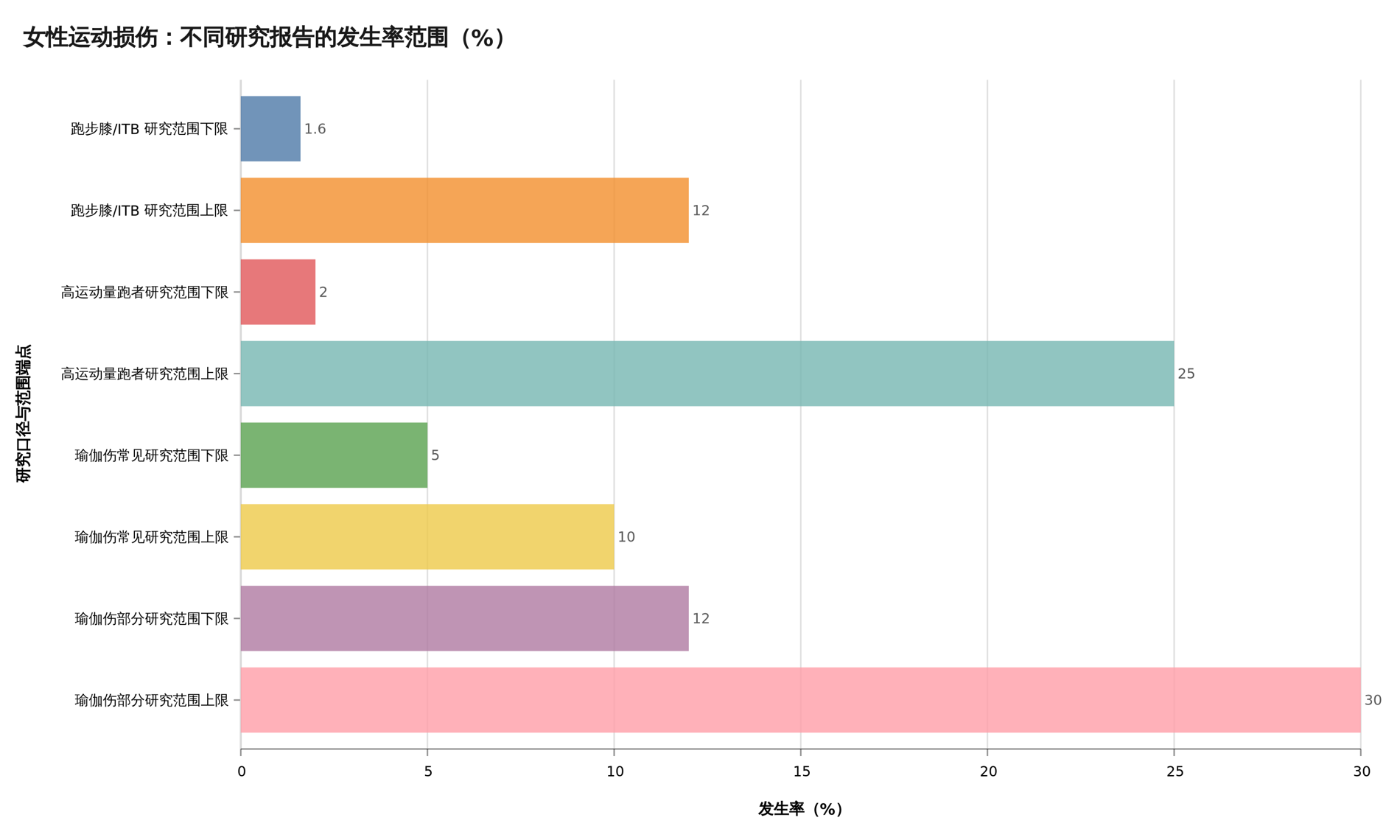
Figure: Ranges of injury incidence (%) reported in different studies for runner’s knee, iliotibial band–related injuries, and yoga injuries.
Explanation of definitions: The figure separately shows the lower and upper limits reported by studies, not precise estimates from a single cohort. Definitions of exercise, samples, and follow-up methods differ, so the groups cannot be directly compared as a ranking.
For yoga, the overall absolute risk is actually lower than that of high-impact exercise. A physical therapy education resource in the United States states that fewer than 1% of yoga practitioners develop an injury that prevents them from continuing to practice [Association]. However, cross-sectional surveys estimate that **5%–10%—and in some studies 12%–30%—**of regular practitioners experience at least one musculoskeletal injury each year [Academic]. Notably, women often account for 80%–90% of yoga class participants, so most reported injuries involve women—65% in an imaging study. This primarily reflects who practices, however, rather than meaning that women are inherently more susceptible to injury [Academic].
Comparing the two: Running injuries are more concentrated in the lower limbs—the knees, lower legs, and soles—and are strongly associated with volume. Yoga injuries are more widely distributed across the spine, shoulders, wrists, and knees, and are strongly associated with pose difficulty, excessive flexibility, and insufficient strength. The following sections examine these two pathways separately.
III. Runner’s knee: a simple name for a complex mechanism

A scene from Bhutan: the ridgeline and prayer flags at Dochula Pass
“Runner’s knee” is not a standardized medical term but a common expression, usually covering two problems: patellofemoral pain syndrome (PFPS) and iliotibial band friction syndrome/syndrome (ITB) [Media].
1. Patellofemoral pain syndrome (PFPS)
This is the most common form. Typical symptoms include an aching pain at the front of the knee when going downstairs, squatting, or standing after sitting with the knee bent for a long time, sometimes accompanied by giving way or clicking. The underlying issue is often an imbalance in the lower-limb strength chain: weak gluteal muscles, weak quadriceps—the muscles at the front of the thigh—and insufficient hip abduction and external rotation strength cause the kneecap to track incorrectly in the femoral groove, with repeated friction leading to inflammation [Academic].
A simple self-observation clue: If your knee “hurts more going downstairs than upstairs,” “feels stiff and sore when standing after prolonged sitting,” or “collapses inward with pain during a single-leg squat,” PFPS is more likely. It is usually diagnosed through symptoms and physical examination rather than imaging; further imaging is needed only when a doctor suspects a meniscus, ligament, or cartilage problem. This is also a reminder: Do not take painkillers indiscriminately and push through the pain, but do not assume that your knee is ruined whenever it hurts. Finding the right cause is the key.
2. Iliotibial band syndrome (ITB)
This causes a sharp or burning pain on the outside of the knee, most often in distance runners and cyclists, and more commonly in women. The cause is excessive tightness of the iliotibial band—a thick strip of fascia along the outer thigh—and repeated friction against the lateral femoral epicondyle. Stretching the band, using a foam roller to release tension, and strengthening the hip abductors are the core approaches [Academic].
Key figures:
The combined incidence of PFPS and ITB among runners is approximately 1.6%–12%; when running volume increases and training becomes more intensive, it can rise to 2%–25% [Academic]. This suggests that:
Injuries are often linked to volume rather than running itself
.
IV. Why runner’s knee affects women more often
This is not prejudice that women have “more fragile knees,” but is associated with identifiable anatomical and training factors:
- A wider pelvis and a larger Q angle. Women have a relatively wider pelvis and a larger mechanical angle from hip to knee—the Q angle—making the kneecap more likely to be pulled outward and increasing the risk of poor tracking. The incidence of knee injuries is approximately twice that in men [Academic].
- Weak hip and gluteal muscles are a hidden contributor. Multiple studies of female runners indicate that insufficient hip abductor and external rotator strength can cause poor knee tracking on landing, contributing to PFPS and ITB [Academic].
- Increasing training too quickly. A common beginner’s mistake is to run hard simply because you feel good that day. Sports medicine generally recommends increasing weekly running volume by no more than 10%, allowing bones, tendons, and cartilage time to adapt [Association].
- Knee alignment. Many people allow their knees to collapse inward during squats and lunges. Ideally, the knee should point toward the second and third toes, avoiding inward collapse that increases pressure on the medial side [Academic].
Practical protection:
Start with a combination of walking and running; choose well-fitting running shoes and avoid prolonged running on hard surfaces; increase weekly volume by ≤10%. Treat wall sits, clamshells, glute bridges, side-lying leg raises, and resistance-band side steps as foundational lessons for running. Practicing them 2–3 times a week for 15–20 minutes per session protects against injury better than running an extra 5 kilometers.
Another often-overlooked factor is landing mechanics. With every running step, the ground reaction force is approximately 2–3 times body weight, transmitted through the hips, knees, and ankles. If the gluteus medius is weak, the pelvis drops on the supporting-leg side, forcing the knee inward and disrupting kneecap tracking. This is the real reason that many women develop knee pain despite having had no collision or blow. In other words, runner’s knee is rarely a problem of the knee alone; an imbalance throughout the kinetic chain comes due at the knee. This also explains why training only the knees and neglecting the glutes often addresses symptoms rather than the root cause.
V. Yoga injuries: the underestimated risks of a “gentle activity”
Yoga is often promoted as “burden-free” or “healing,” but orthopedic and imaging research repeatedly reminds us that every physical activity carries an injury risk, and yoga is no exception [Association]. Its risks mainly arise from three factors: pursuing flexibility excessively, insufficient strength, and incorrect alignment in poses.
Lower back
The most common site of yoga injury, followed by the neck/wrists/knees/shoulders [Academic]
↑80%
Increase in yoga-related emergency injuries over seven years in one region, compared with a 5.5% increase in participation [Media]
20–39 years
Emergency presentations for yoga injuries frequently involve young women, mainly because of popular inversion poses on social media [Media]
A study based on radiology records found that women accounted for 65% of yoga injuries. The researchers specifically noted that women often have greater overall flexibility but weaker upper-body strength, resulting in a higher incidence of shoulder pain. Although men practice less, their relative risk was higher [Academic]. Another Australian study examined 118 yoga-related emergency injuries between 2009 and 2016. Approximately 10% were severe enough to require hospitalization, mainly knee injuries and shoulder dislocations, followed by head and neck and lower-back injuries. The researchers partly attributed this to social-media influencers: attempting difficult poses for photographs without adequate warm-up [Media].
Risk warning:
Tendons and fibrocartilage are the structures most susceptible to yoga injuries. Extreme leg-behind-head poses may strain the iliotibial band, distal biceps tendon, or lateral collateral ligament, or even tear the acetabular labrum. In people with pre-existing disc degeneration, excessive forward bending increases intradiscal pressure and may trigger a herniation [Academic].
The social-media era has introduced another trigger for yoga injuries: performance for an audience. Researchers analyzing emergency data stated directly that many serious injuries arose from attempting difficult poses for photographs without sufficient warm-up. Headstands happen to be among the poses most frequently shown by women on social media [Media]. When practice is driven by check-ins and likes instead of bodily sensation, protective elements such as alignment, breathing, and strength are sacrificed. This is a reminder for every form of exercise: Performing movements beyond your current ability in front of a camera can multiply the risk severalfold. Truly mature practice is precisely the kind that does not need to prove anything to anyone.
VI. A map of common yoga injuries
People in Bhutan: a young woman’s traditional clothing and everyday life
| Area | Associated poses / movements | Why injury occurs |
|---|---|---|
| Neck | Headstand, shoulder stand, Plow Pose | Too much body weight is borne by the neck; inadequate support compresses discs or nerves [Association] |
| Shoulder | Shoulder stand, Downward-Facing Dog, Chaturanga, arm balances | Subacromial impingement and rotator-cuff strain; women with weaker upper-body strength are more susceptible [Academic] |
| Wrist | Weight-bearing poses such as Downward-Facing Dog and Crow Pose | Prolonged weight-bearing and compensatory loading at the wrist can cause carpal-tunnel discomfort [Association] |
| Lower back | Forward bends, backbends, twists, Boat Pose | Core instability and excessive spinal flexion or extension; greater risk in people with disc degeneration [Academic] |
| Knee | Lotus, Hero Pose, King Pigeon Pose | Insufficient hip mobility leads to compensatory twisting of the knee; deep flexion plus rotation can injure the meniscus and ligaments [Academic] |
| Hamstrings | Excessive forward bending and ballistic stretching | Pulling forcefully with straight legs strains the muscles [Association] |
Three groups face relatively greater risk: those practicing demanding styles such as hot yoga, power yoga, or Ashtanga; those with joint hypermobility—a naturally very flexible body—the more flexible you are, the more restraint you need, because instability can make injury more likely [Association]; and postmenopausal people with existing osteoporosis, for whom extreme spinal flexion or extension may cause compression fractures and poses need substantial modification, such as chair yoga [Association].
VII. Shared principles of scientific protection
Whether running or practicing yoga, the logic of protection is very similar. Remember it as “five don’ts and five dos”:
Five don’ts:
Do not compare your progress with others; do not copy influencers’ movements uncritically; do not lock your joints, particularly your knees; do not hold your breath while forcing a position; and do not keep exercising through pain.
Five dos:
Warm up and activate your muscles; progress gradually; build a strength foundation; use props such as yoga blocks or straps; and listen to your body.
After an injury, a yoga teacher with 20 years of teaching experience reduced her practice to 80%–85%: “Practice to your edge, not beyond it.” This is the golden rule for every form of exercise [Media]. Physical therapists also repeatedly stress that when stretching changes from a comfortable lengthening sensation to pain, it is time to stop. Muscle soreness the day after exercise is normal, but genuine sharp pain, joint swelling, or restricted movement means you have gone too far [Association].
Another overlooked point is combining yoga with strength training. Stretching without strength makes joints like loose screws. Adding resistance training 2–3 times a week creates genuine stability through a balance of flexibility and strength [Association]. This continues the discussion in our previous articles on building muscle in women and Baduanjin: exercise should combine several layers rather than depend on a single activity.
Once an injury has occurred, protection needs to become a graded return to exercise. The first stage is to relieve pain, reduce inflammation, and restore range of motion—often requiring a pause in painful movements, though not necessarily complete bed rest. The second stage addresses strength deficits in the glutes, core, rotator cuff, and calves. The third stage gradually reintroduces the original activity under low load, starting with short durations and low intensity while closely monitoring whether pain returns. This approach of repairing the foundations before returning to the road is far safer than immediately resuming the previous volume once the injury feels better, and is more effective at preventing reinjury.
VIII. A perspective for women aged 40+: hormones, bone mass, and overlapping risks
For women aged 40+, exercise injuries have an additional background:
- Estrogen fluctuations make ligaments “looser.” Hormonal changes around menstruation and during perimenopause increase laxity in ligaments and joint capsules, temporarily reducing joint stability and slightly increasing the risk of ankle sprains and knee twists. This does not mean you cannot exercise; it is a reminder to reduce inversions, deep backbends, and vigorous twisting during menstruation, focusing on gentle stretching instead [Media].
- Bone mass starts declining. Women lose bone mass each year after age 40, with faster loss after menopause. For those with osteoporosis, extreme flexion and extension in yoga and the high impact of running require caution. A doctor or rehabilitation professional should assess whether lower-impact exercise or modified poses are needed [Association].
- Pregnancy and postpartum. Avoid abdominal compression and inversions during pregnancy. After childbirth, especially before pelvic-floor recovery, postpone jumping and poses that sharply increase intra-abdominal pressure. High-intensity exercise is usually recommended only after assessment at three months postpartum [Media].
- Chronic conditions and old injuries. If you have knee arthritis, a rotator-cuff injury, or a history of lumbar-spine problems, discuss what you can practice and what to avoid with your treating doctor or rehabilitation professional before beginning any new activity.
- Recovery capacity declines with age. After 40, tissue repair and tendon adaptation slow down. A younger person may recover from the same training volume after a night’s sleep, while we may need two days. Treating active rest as part of training rather than laziness is a more honest form of respect for the body.
A reminder for those aged 40+:
Age is not the enemy of exercise;
blindness is
. Make annual health checks, pre-exercise assessment, and listening to your body as routine as skin care. They are more useful than any protective equipment.
IX. Common misconceptions, red flags, and a recording template

A scene from Bhutan: a Himalayan valley and rural landscape
Five misconceptions that most need correcting
- “Pushing through pain is what makes exercise effective.” Wrong. Soreness and sharp pain are different; pain is the body asking you to stop.
- “Doing only one activity is safest.” Wrong. Repetitive activity can create overuse injuries, while cross-training offers better protection.
- “Just copy the influencer’s movement.” Wrong. Everyone has different anatomy, old injuries, and flexibility. Following along without feedback is particularly likely to cause injury.
- “The knee must be locked straight for correct form.” Wrong. Keep a slight bend in the knees during poses such as standing forward bends to protect the menisci and hamstrings.
- “Flexibility is always good; the more flexible, the stronger.” Wrong. People with hypermobility need strength to address deficits rather than more stretching.
Red flags—seek medical care or rehabilitation assessment promptly if they occur:
① Persistent joint pain lasting more than one week or recurring repeatedly; ② obvious swelling, warmth, or bruising; ③ limited movement, such as difficulty walking, squatting, or raising an arm; ④ neurological symptoms such as numbness, radiating pain, or weakness; ⑤ deformity or inability to bear weight after an acute injury. These are not signals that more exercise will make things better.
Consultation record template—more useful when brought to a doctor or rehabilitation professional:
· When did the pain start, and during which movement?
· Where is it, what does it feel like—sharp, aching, or burning—and does it radiate?
· What types of exercise do you do each week, how often, and how much has the amount increased in the last month?
· Do you have old injuries, a surgical history, osteoporosis, or arthritis?
· Does rest relieve it, and what makes it worse?
X. Nine questions readers ask most often
- Does runner’s knee mean I can never run again?
Most PFPS and ITB are functional problems, not evidence that the knee is ruined. First reduce volume, stop painful movements, and strengthen the glutes, legs, and core. Returning to exercise is often possible after several weeks. Severe acute pain, swelling, or locking requires medical assessment first to rule out problems such as a meniscal injury.
- Can yoga injure the lower back even though it is so gentle?
Yes. Forward bends, backbends, and twists are particularly likely to injure the lower back when the core is unstable or disc degeneration already exists. Maintaining spinal length, engaging the abdomen, and using blocks to share the load matter more than going deep enough.
- Can I practice yoga or run during menstruation?
Low-intensity gentle yoga and brisk walking are possible. Avoid inversions, deep backbends, vigorous twists, and high-impact running. Let physical comfort guide you, without forcing yourself.
- Does using props—blocks, straps, or mats—mean I am not good at it?
Quite the opposite: using props well is a sign of a mature practitioner. They help you work within the right range rather than force a pose through compensation.
- What is the safest way to begin exercising after 40?
Start with low-impact activities such as brisk walking, swimming, chair yoga, or Baduanjin, adding light resistance training 2–3 times a week to build a strength foundation. Have an assessment first if you have a chronic condition or osteoporosis. Increase gradually and keep detailed records.
- Does a clicking knee mean it is deteriorating?
Painless clicking alone usually comes from gas bubbles or tendon movement and need not cause alarm. Clicking accompanied by pain, catching, or swelling requires assessment.
- After an injury, how do I know whether to see orthopedics or rehabilitation medicine?
Acute trauma, deformity, or inability to bear weight calls first for emergency or orthopedic care. Rehabilitation medicine is more appropriate for chronic aching, restricted function, and a systematic return to exercise. The two often work together.
- Which is friendlier to people over 40: running or yoga?
Neither is absolutely better; it depends on your starting point. For people with healthy joints and a strength foundation, running is efficient cardiovascular training. For those with good flexibility but weak strength or low bone mass, gentle yoga plus resistance training is a steadier option. Ideally, combine the two to benefit from each.
- Do foam rollers and massage guns count as treatment?
They are tools for relaxation and recovery that can relieve tension and improve comfort, but they cannot replace strength training or medical assessment. If pain keeps returning after relaxation, the underlying issue is more likely to involve strength and alignment than muscles being too tight.
XI. Closing: understanding the body is informed choice in exercise

A scene from Bhutan: mountain settlements and natural scenery
Return to the two classmates at the start. They did not give up exercise; they changed how they practiced. One replaced hard running with walking–running intervals and regular glute bridges, and her knee gradually settled. The other replaced a deep Wheel Pose with Bridge Pose and core activation; her back felt easier, and she enjoyed practice more. Exercise is never about competing for an audience, but about building a long-term partnership with the body.
Scientific protection ultimately means three things: knowing the risks—where runner’s knee and yoga injuries come from; knowing your limits—working at 80% and stopping when it hurts; and knowing when to seek help—bringing records to a doctor or rehabilitation professional for shared decisions. This informed understanding of your body is more dependable than any protective equipment or class.
Finally, a word for everyone who loves moving: pain is not a label of weakness, and pushing through it is not a medal of strength. Truly capable people know when to slow down and when to add more. May you move with enjoyment, and keep moving for many years.
A quick literature guide for clinician readers—not a complete review; for further reading
- Runner’s knee commonly encompasses PFPS and ITB. Female knee-injury incidence is approximately twice that in men and is associated with a wider pelvis, larger Q angle, and weak hip and gluteal muscles [Academic]. Conservative exercise therapy—wall sits, clamshells, glute bridges, and side steps—is first-line; a weekly running-volume increase of ≤10% is recommended [Association].
- The absolute risk of yoga injury is lower—<1% leads to stopping practice—but surveys report annual incidence of 5%–10%, or 12%–30% in some studies. The lower back is the most common site, followed by the neck/wrists/knees/shoulders. Women account for most reports because participation is high, while men have higher relative risk [Academic].
- An AJR imaging study (2011): Women accounted for 65% of yoga injuries, with tendons and fibrocartilage most susceptible. Leg-behind-head poses were associated with iliotibial-band/lateral-collateral-ligament strains and acetabular labral tears. Forward bending increases pressure within degenerated discs [Academic].
- Sekendiz et al. (Australia, 2018 conference): There were 118 emergency yoga injuries during 2009–2016, increasing by approximately 80% over seven years, while participation rose only 5.5%. Approximately 10% required hospitalization, mainly for knee injuries and shoulder dislocations. Young women were commonly affected, with some cases attributed to social-media poses [Media].
- UW Health / osteoporosis guidance: Postmenopausal people and those with osteoporosis should avoid extreme spinal flexion and extension to prevent compression fractures. People with hypermobility should avoid excessively deep stretches. Combining yoga with structured strength training and using props appropriately is advised [Association].
- Mount Elizabeth (2018) lists five injuries among female runners: PFPS, stress fractures—including the female athlete triad—ITB, shin splints, and plantar fasciitis. The central mechanism is weak hip abduction/external rotation leading to poor knee tracking [Academic].
Annotation key: Bracketed labels identify the type of information. Industry statistics and social-media data are often not peer-reviewed and are provided only as educational references. Individual diagnosis and treatment should follow local guidelines and the treating doctor’s judgment.
Disclaimer: This article provides health education and cannot replace an in-person diagnosis or treatment advice from a doctor. Its data come from published literature and industry reporting, and individual differences are substantial. Consult a qualified medical institution and treating doctor about medication, surgery, or rehabilitation plans. Seek care promptly for persistent pain, swelling, restricted movement, or neurological symptoms.
This publication does not recommend any particular brand, protective equipment, or course and does not constitute commercial promotion.
Additional research and boundaries of the evidence
- Sports-medicine consensus statements from ACSM and the IOC emphasize assessing training load, recovery, sleep, and previous injuries together; injury cannot be attributed to one movement or one sex-related factor alone.
- Studies of patellofemoral pain, running-related injuries, and yoga injuries in women are mostly observational studies or systematic reviews. They suggest associations with risk factors, not that a particular exercise will necessarily cause injury.
- Menstrual cycles, energy availability, and bone health should be assessed alongside individual medical history. Persistent swelling, joint instability, or neurological symptoms require professional assessment.
International literature and data comparison
| Source | Judgment supported | Relationship to the figures in this article |
|---|---|---|
| ACSM’s Guidelines for Exercise Testing and Prescription, 11th edition | Gradual progression, load management, and risk screening | Supports interpretation of running-volume increases, recovery, and red flags |
| IOC 2023 RED-S consensus | Energy availability, menstruation, and bone health need joint assessment | Provides mechanistic context for the section on risks in women aged 40+, without presenting association as causation |
| International patellofemoral pain research consensus (BJSM) | Exercise therapy and the hip–knee kinetic chain are central management approaches | Corresponds to the PFPS incidence range and strength-training advice |
Read the source material
The original archive manuscript is restored above. These additional references offer context; their inclusion does not constitute medical validation of every original claim. Clinical and regional terminology review are pending.
A good question starts a conversation.
Explore a related editorial discussion. Reading is open to everyone; posting and replying require a free reader account.
More from the library
 Movement & strength · 14 MIN READWomen and Muscle Building: From the Ideal of Being “Fair-Skinned, Thin, and Youthful” to Strength↗
 Movement & strength · 14 MIN READBaduanjin: A Practical, Evidence-Based Guide to Gentle Movement↗
 Nutrition & evidence · 13 MIN READSoy, Isoflavones, and Equol: Can That Bowl of Soy Foods Really “Replenish Estrogen” After 40?↗