Hair Loss Is Not Simply “Deficiency”: What Hormones, Childbirth, and Stress Reveal About Your Hair
Thinning hair can feel unsettling, but “hormone imbalance” is not an answer to every kind of hair loss. Notice the pattern and seek assessment when needed.

In this article
Evidence-based health education for women 40+ | This article is health education and does not constitute medical advice
I. She turned her phone around: “My part is a finger-width wider than six months ago”
A real view of Bhutan: Punakha Dzong and the river valley
Last weekend, I met my college roommate at a café in a shopping mall. She turned her phone screen toward me to show a selfie: her part was a finger-width wider than six months ago. “It started falling out after my second baby. The child is a year old now, and my hair still has not come back.” As she spoke, her mother, sitting beside her, put food on her plate and casually added, “Eat more black sesame. Like nourishes like.”
This is the first “advice” many women receive about shedding hair. But hair volume is far more complicated than “like nourishes like.” It involves hormonal tides, physiological adjustment after childbirth, and two especially overlooked threads: stress and the thyroid. Before paying for any “miracle product,” perhaps we should first understand the message our body is sending through our hair.
She is far from alone in thinking this way. Open Xiaohongshu and posts about “postpartum shedding,” “stress baldness,” and “thyroid hair loss” appear one after another, with comment sections full of “me too.” Social platforms amplify individual anxiety into collective panic, but popularity is not truth. What actually matters is separating emotion from evidence: first work out which category applies to you, then decide what to do next.
II. First distinguish normal shedding from actual hair loss
First, set aside unnecessary panic. People normally shed 50–100 hairs each day as part of normal follicle turnover【Tencent Medical Encyclopedia; Minfukang】. Seeing many hairs when washing or brushing often simply means seeing a “concentrated display” of hair that was due to fall out anyway; it does not necessarily indicate illness.
These are the signals that deserve attention:
- Daily shedding persistently exceeds 100 hairs and does not decrease over several weeks;
- Hair becomes visibly thinner, the part widens, or the hairline recedes;
- Hair becomes finer, softer, and more prone to breakage overall;
- Round or oval patches of hair loss appear on the scalp.
If any of these occurs, the next step is dermatology or endocrinology, rather than filling a cupboard with anti-hair-loss shampoos.
One useful clinical detail: doctors often perform a “hair-pull test,” gently holding a small bundle of roughly 25–50 hairs between finger and thumb and slowly pulling upward. More than 4 hairs coming away suggests possible telogen effluvium; blood tests and dermoscopy then help determine the type【Tencent Medical Encyclopedia】. This is much more reliable than diagnosing yourself in the mirror. Remember, too, that seeing a few dozen hairs while washing or brushing is usually just a concentrated display of normal turnover, rather than a reason for daily anxiety.
85–90%
The proportion of follicles on a normal scalp in the “growth phase.” The remaining 10–15% are resting; after approximately 3 months they naturally shed and new hair grows【Liao Eryuan and Mo Zhaohui, “Classification and Treatment of Hair Loss in Women,” People's Medical Publishing House Knowledge Digital Service System, 2025】.
III. How hormones “direct” the hair

A real view of Bhutan: mountain ridges and prayer flags at Dochula Pass
Hair does not grow continuously. It has a life cycle: anagen, the growth phase, lasting around 2–6 years and accounting for 85–90% of hairs → catagen, the transition phase → telogen, the resting phase, lasting approximately 3 months and accounting for 10–15%. Estrogen extends the growth phase and shortens the resting phase; androgens, particularly their active form DHT, shorten the growth phase, making hair finer and causing it to shed.
After childbirth: a collective shutdown after an “extended standby.”
During pregnancy, estrogen rises, extending the follicles' growth phase and reducing shedding. After delivery, estrogen falls abruptly, and many follicles enter the resting phase together. The literature reports that postpartum,
approximately 30%–45%
of women experience this telogen effluvium【Tencent Medical Encyclopedia: postpartum hair-loss incidence approximately 35%–45%; Minfukang review】. Shedding usually begins 2–4 months after delivery and peaks at 3–5 months.
After 40 and during menopause: a relative rise in androgens.
With increasing age and declining ovarian function, estrogen falls while androgens account for a relatively larger share, increasing the risk of female pattern hair loss (FPHL). According to the review by Liao Eryuan and Mo Zhaohui, female pattern hair loss affects
approximately 12% after age 30
,
and as many as 30%–40% above age 60
【Research】. Its typical presentation is gradual thinning at the crown and along the part, rather than “baldness.”
The elevated androgens associated with polycystic ovary syndrome (PCOS) may also present as thinning at the crown. After stopping contraceptive pills, a period of shedding can also occur because progesterone metabolites have androgenic characteristics【Liao Eryuan and Mo Zhaohui】. The same outward “hair loss” can therefore have very different hormonal scripts behind it.
Looking at the three most common forms of “women's hair loss” together makes things clearer:
| Type | Main trigger | Typical presentation | Timeline and outcome |
|---|---|---|---|
| Postpartum telogen effluvium | Abrupt postpartum estrogen decline | Diffuse, even thinning; hairline usually preserved | Peaks 2–5 months postpartum; usually resolves spontaneously at 6–12 months【Tencent Medical Encyclopedia; Minfukang】 |
| Female pattern hair loss, FPHL | Genetics plus androgen sensitivity and age-related estrogen decline | Thinning at the crown or part; slow progression; complete “baldness” is rare | Chronic, progressively worsening over time; approximately 12% after 30 and 30%–40% above 60【Liao Eryuan and Mo Zhaohui】 |
| Stress-related telogen effluvium | Increased cortisol from acute stress or prolonged pressure | Diffuse shedding; resting follicles temporarily rise to 30%–50% | Recovery 2–3 months after the trigger is removed; prolonged stress may lead to chronic telogen effluvium (CTE)【Minfukang / Nie Xiaojuan】 |
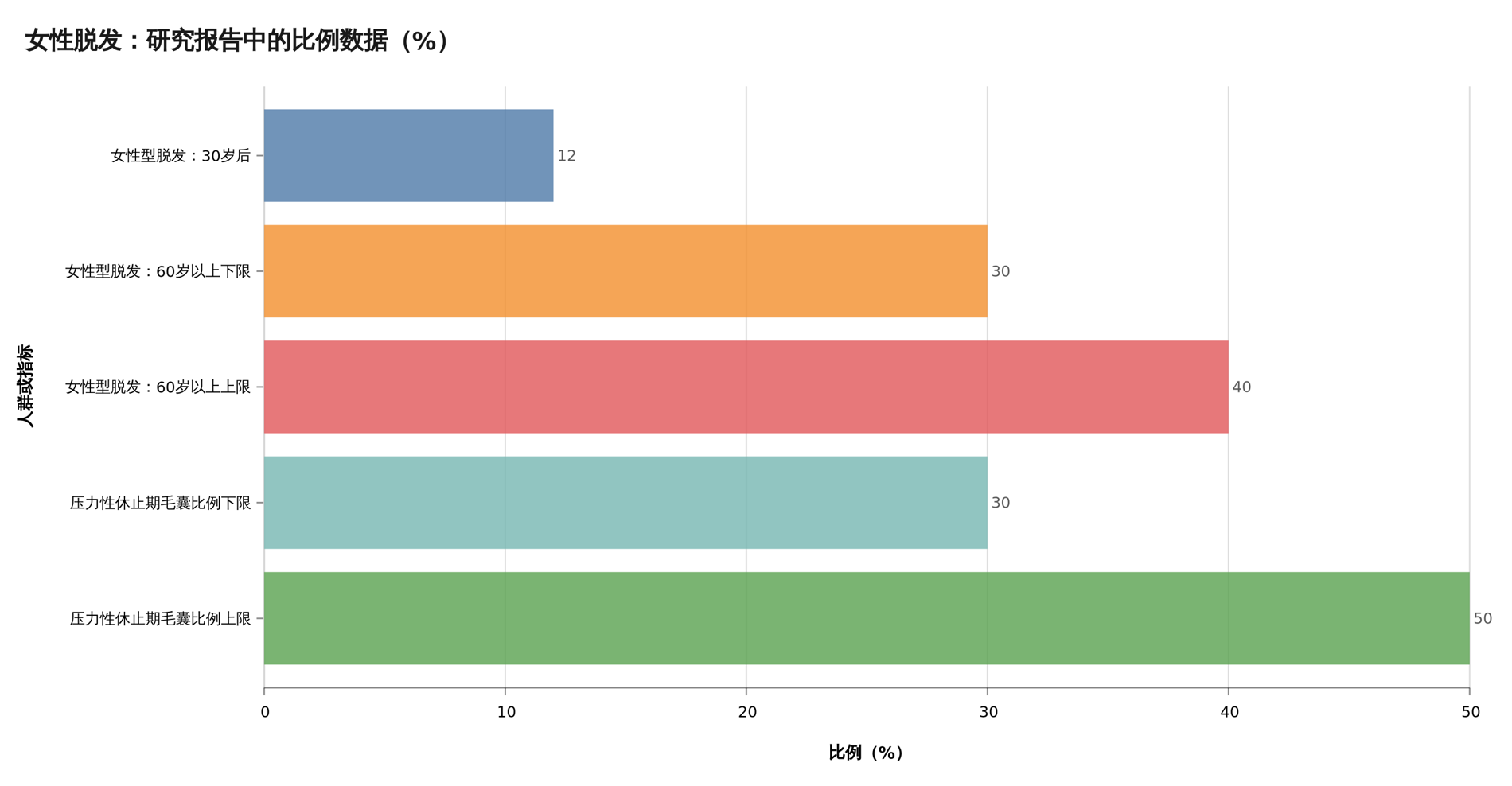
Figure: visualization of percentage data for female pattern hair loss and stress-related telogen effluvium from the original table (%).
Definition note: “peak at 2–5 months and recovery at 6–12 months” for postpartum shedding is a timeline and has not been converted into a proportion. Age groups, definitions of hair loss, and study populations differ; the values in the figure should not be added together or used for direct cross-group inference about an individual's risk.
Note: the first two types and the third type in the table mostly involve “diffuse thinning.” Sudden, clearly demarcated round patches are often something else: alopecia areata, an autoimmune form of hair loss requiring a different dermatological approach. Do not confuse it with telogen effluvium.
IV. Postpartum hair loss: a “delayed” physiological adjustment
First, some reassurance for postpartum mothers: the vast majority of postpartum hair loss is a self-limiting physiological phenomenon, not a disease【Tencent Medical Encyclopedia; Minfukang】. The usual course is:
- 2–4 months: noticeable shedding begins;
- 3–5 months: shedding peaks;
- Around 6 months: gradual improvement;
- 7–12 months: most people can see fine, soft “baby hairs” growing back.
But “most cases improve” does not mean “every case is normal.” A 2025 international review by The Derm Spot specifically highlighted several red flags that warrant early medical investigation rather than simply waiting:
Red flags in postpartum hair loss:
- Heavy shedding continues beyond 9–12 months without improvement;
- New patches of hair loss appear;
- The scalp is red, swollen, scaly, itchy, or painful;
- Fatigue, weight changes, feeling cold, or palpitations occur at the same time—potentially suggesting thyroid problems, iron deficiency, or inadequate vitamin D.
Suggested tests include TSH, free T4, ferritin, vitamin D, B12, and zinc【The Derm Spot 2025 review】.
“Waiting for recovery” does not mean “doing nothing.” During this postpartum window, several proactive steps have evidence behind them:
- Get enough protein: hair is mainly keratin. Daily protein needs increase during breastfeeding, with approximately 1.2 grams per kilogram of body weight recommended, from fish, eggs, lean meat, and soy foods【Minfukang / FH Health】;
- Pay attention to iron stores: pregnancy requires more iron and delivery consumes it. Low ferritin can slow follicle recovery. When necessary, take iron under medical guidance, alongside vitamin C to support absorption;
- Use gentle care: reduce traction with a wide-toothed comb, avoid overly hot water—around 37°C is suggested—reduce perming and coloring, and massage the scalp gently to encourage blood flow;
- Manage sleep and emotions: catch up on sleep around the baby's sleep pattern, share care with family, and screen for postpartum mood problems when needed, for example with PHQ-9. Psychological stress itself can worsen shedding.
6–12 months
The window in which most postpartum telogen effluvium resolves spontaneously. If shedding has not improved after 9–12 months, or patches, scalp inflammation, or systemic symptoms appear, seek medical care promptly instead of continuing to “wait”【The Derm Spot 2025; Tencent Medical Encyclopedia】.
Medication requires particular caution during breastfeeding. Topical minoxidil has relatively little systemic absorption, and some doctors permit its use while breastfeeding, but confirmation from an obstetrician or pediatrician is still needed. Oral finasteride, dutasteride, and high-dose vitamin A should generally be avoided or used cautiously during breastfeeding【The Derm Spot 2025】. Have a physician assess any oral preparation.
V. Stress and the thyroid: two underestimated threads

A real view of Bhutan: Thimphu city and traditional architecture
For many people, hair loss begins with a period of high-pressure living. Acute stress or sustained pressure raises cortisol through neuroendocrine pathways, shortening the follicles' growth phase. The literature notes that stress-related telogen effluvium can temporarily increase the proportion of resting follicles to 30%–50%, producing diffuse thinning, usually visible 2–3 months after the trigger【Minfukang/Nie Xiaojuan review】. The good news is that gradual recovery usually occurs 2–3 months after the trigger is removed. However, prolonged stress can turn this into chronic telogen effluvium—CTE, lasting more than 6 months—which requires more active intervention.
Why can stress make hair shed? In simplified terms, prolonged pressure keeps the hypothalamic–pituitary–adrenal axis activated, raising stress hormones such as cortisol and disrupting follicular growth rhythms: the growth phase shortens, and more follicles enter the resting phase prematurely. Sleep deprivation also increases corticotropin-releasing hormone (CRH), further reducing the follicles' “working time”【Minfukang review】. This explains why someone may suddenly notice “so much shedding” two or three months after an exhausting stretch: stress and hair loss are naturally separated by a delay of several months.
For this reason, hair loss is often a lagging signal. When you see a widening part in the mirror, the useful question is not “what am I missing today?” but “what has my body been through over the past six months or more?” Treating it as a bodily reminder is more useful than treating it as a failure of appearance.
The thyroid: both overactivity and underactivity can cause shedding.
Abnormal thyroid function affects follicles through immune regulation and metabolic disruption, often accompanied by “whole-body” signals such as feeling cold, palpitations, weight fluctuations, and mood changes【Minfukang; Tencent Medical Encyclopedia test items】. Pay particular attention to
postpartum thyroiditis
—which may present after childbirth with a hyperthyroid or hypothyroid phase and cause diffuse hair loss. TSH and FT4 testing are needed to identify it【Minfukang/FH Health】.
In real life, these factors often overlap: a postpartum woman may simultaneously experience an abrupt hormonal decline, sleep deprivation, parenting stress, and potential thyroid fluctuations. Simply labeling shedding as “deficiency” can miss the causes that actually need treatment.
VI. A 40+ perspective: investigate perimenopausal hair changes before trying to “rebalance” them
For readers over 40, changes in hair volume are more likely to relate to the hormonal transition. As estrogen falls further, female pattern hair loss may progress slowly, typically with thinning at the crown or part, medically called the Ludwig pattern, or “Christmas tree” thinning along the frontal midline, while the hairline is mostly preserved【Liao Eryuan and Mo Zhaohui】. Progression is slow and symptoms are mild, but it persists.
The key action is not rushing to “tonify the kidneys” or buy anti-hair-loss products, but investigating first:
- Thyroid function, TSH and FT4;
- Ferritin, to assess hidden iron deficiency;
- Sex hormone levels;
- Nutrients such as vitamin D, B12, and zinc.
The same “hair loss” could reflect PCOS-related androgen excess, thyroid disease, iron deficiency, or simply age-related FPHL, each requiring a different response. Estrogen is lower after menopause, but FPHL usually progresses slowly. Rapid shedding over a short period makes it especially important to investigate other concurrent factors.
When consulting a doctor after 40, you can actively clarify:
- Whether thyroid function, TSH and FT4, and ferritin have been checked—these are two common “silent” factors;
- Whether menstrual changes, hot flashes, and mood swings suggest the perimenopausal hormonal transition and should be considered alongside the hair loss;
- Whether there is a history of PCOS or signs of androgen excess, such as acne, excess body hair, or infrequent periods;
- Whether current medication might affect the hair, such as certain blood-pressure drugs, antidepressants, or transitions between contraceptive pills.
Considering hair loss within the “whole-body hormonal picture” often gets closer to the cause than focusing only on the scalp.
VII. Stay on track: common misconceptions, reasons to seek care, and an appointment log
With hair loss, “home remedies” always move faster than evidence. The following misconceptions deserve individual scrutiny.
Misconception 1: ginger, he shou wu, and black sesame regrow hair through “like nourishes like”
Dietary remedies can provide some protein and trace elements, making them part of nutrition, but they cannot replace treatment of the cause. One point particularly needs emphasis:
He shou wu carries a risk of liver injury
; breastfeeding women especially should not take it independently【Minfukang medication warning】. Placing hope in a single “miracle herb” wastes time and may cause harm.
Misconception 2: daily washing makes more hair fall out
Gentle cleansing does not itself cause hair loss. Very hot water, strongly alkaline products, excessive traction, and frequent perming or coloring do damage hair. Hairs shed during washing are resting-phase hairs that were due to fall out.
Misconception 3: hair loss means “kidney deficiency,” so supplements are urgently needed
Causes of hair loss in women span hormones, nutrition, immunity, thyroid function, and psychological stress, far beyond a generic “deficiency.” Taking supplements indiscriminately without investigation can conceal real problems such as anemia or hypothyroidism.
Misconception 4: anti-hair-loss shampoo or a hair-growth device equals a cure
Shampoo mainly improves the scalp environment and cannot reverse hormonal or scarring hair loss. Low-level laser therapy (LLLT) has some supporting evidence, but is an
adjunctive
approach, rather than “instant regrowth” magic【The Derm Spot 2025】.
Misconception 5: buy oral medication and “try it out” yourself
Oral antiandrogens and finasteride-class drugs have contraindications and side effects; they require medical assessment. The risks of self-medication far outweigh that small convenience.
When to seek care: a red-flag checklist:
- Round or oval patches of hair loss;
- Shedding that persists beyond 12 months without improvement, or progressively worsens;
- Scalp redness, swelling, scaling, itching, or pain;
- Fatigue, marked weight changes, feeling cold or palpitations, or menstrual irregularity;
- A noticeably receding hairline.
A “hair-loss log” to take to your appointment:
- Estimated daily shedding, separately for the pillow, brushing, and washing;
- When shedding began, and whether it followed childbirth, a stressful event, or dieting;
- Changes in the part or hairline—monthly photos from the same angle are more reliable than memory;
- Accompanying symptoms involving fatigue, periods, mood, or weight;
- Recent nutrition, dieting, and medication history.
This record helps a doctor identify clues within minutes and saves you wasted effort.
A genuinely useful, evidence-based everyday checklist:
- Get enough protein and iron: hair is keratin. Prolonged dieting and iron deficiency make it brittle and prone to breakage. Red meat, animal liver, and dark green vegetables are good iron sources; vitamin C improves absorption;
- Avoid prolonged extreme dieting: rapid weight loss commonly triggers telogen effluvium, often appearing only 2–3 months after the weight is lost;
- Care gently: wash with warm water, use a wide-toothed comb, reduce perming and coloring, and avoid constantly wearing a tight high ponytail, which can cause traction alopecia;
- Actively reduce stress: regular sleep, mindfulness, and exercise to lower cortisol are part of addressing the cause of stress-related shedding;
- Stop smoking and limit alcohol: smoking constricts scalp capillaries and affects follicular blood supply; alcohol aggravates scalp “damp-heat,” neither helping the hair【Liao Eryuan and Mo Zhaohui】;
- Be cautious about viral anti-hair-loss products: reserving that budget for proper laboratory testing and an in-person medical consultation offers the best value.
VIII. Readers' questions: Q&A

A real view of Bhutan: Himalayan valleys and rural scenery
Q1: Does postpartum hair loss require estrogen supplementation?
Physiological postpartum hair loss is usually self-limiting and generally does not rely on estrogen supplementation. Only when a specific problem, such as low estrogen or thyroid disease, has been established should the underlying condition be treated. A physician should decide whether medication is appropriate.
Q2: Can black sesame or black beans regrow hair?
They provide some protein and trace elements and can be part of a balanced diet, but cannot replace treatment of the cause. Excess fat intake may instead increase scalp sebum production. Treat them as foods, not medicines.
Q3: Can wearing a high ponytail for a long time cause hair loss?
Prolonged pulling can cause “traction alopecia.” Wear hair more loosely, change styles frequently, and avoid tight pulling on the same area year after year.
Q4: Can hair lost through stress grow back by itself?
Most cases gradually improve over 2–3 months once the trigger is removed. But if stress persists and shedding lasts longer than 6 months, consider chronic telogen effluvium, actively reduce stress, and seek care.
Q5: Can women over 40 with female pattern hair loss use minoxidil?
Topical minoxidil is one evidence-supported option, but suitability requires medical assessment, including cardiovascular concerns and the possibility of excess facial hair. It belongs to the category of prescription medicines; follow your doctor's instructions.
Q6: If the thyroid causes hair loss, will treating it bring the hair back?
Most cases improve after thyroid function is corrected, but this takes time, and concurrent forms of hair loss must also be excluded. Do not focus on one item alone.
Q7: How can I communicate efficiently with the doctor?
Bring the hair-loss log above, monthly comparison photos, and your medication history. These substantially improve the efficiency of the consultation and reduce wrong turns.
IX. Closing: let anxiety fall away, and keep your clarity
Hair volume is, in fact, a letter from the body. Hormonal tides, postpartum adjustment, the tension of stress, and the warning light of the thyroid are all hidden in each strand. Before paying for any “miracle product,” read the letter: bring a record to dermatology or endocrinology and let the data speak.
For those of us over 40, real confidence does not mean “never shedding hair.” It means knowing why we are shedding, what to investigate, and when to seek help. Being informed is the least expensive and most reliable “hair-growth serum.” The next time you see a post promising “regrowth in three days,” smile to yourself first: an advertisement does not get to decide what happens to my hair.
Key points to remember in one image:
- Do: distinguish normal shedding from actual hair loss → take records and photos to dermatology or endocrinology → test TSH, ferritin, sex hormones, and vitamin D → treat according to the cause;
- Do not: label all shedding as “deficiency” and supplement indiscriminately, trust liver-damaging remedies such as he shou wu, buy oral medication independently, or rely on shampoo alone as “treatment”;
- One sentence for women 40+: hair changes are often a “concert” involving hormonal transition, the thyroid, iron, and stress; focusing only on the scalp misses the real clues.
A quick literature guide for clinicians

A real view of Bhutan: mountain settlements and natural scenery
- Liao Eryuan and Mo Zhaohui, “Classification and Treatment of Hair Loss in Women” (People's Medical Publishing House Knowledge Digital Service System, 2025-10): hair loss in women mainly comprises female pattern hair loss, postpartum loss, and endocrine-related loss. FPHL affects approximately 12% after 30 and 30%–40% above 60. Patterns include Ludwig, Christmas tree, and Hamilton. Diagnosis must first exclude PCOS-associated androgen excess, thyroid abnormalities, and chronic telogen effluvium (CTE).
- Tencent Medical Encyclopedia, “Postpartum Hair Loss”: incidence approximately 35%–45%, beginning 2–3 months postpartum, with abrupt estrogen decline as the main cause. A hair-pull test yielding >4 hairs and a resting-hair count >25% assist diagnosis.
- Minfukang / Nie Xiaojuan review: stress-related telogen effluvium can temporarily raise the proportion of resting follicles to 30%–50%. Iron deficiency, ferritin <20 ng/ml; vitamin D deficiency, <20 ng/ml; and inadequate protein, <0.8 g/kg, are all associated with shedding.
- The Derm Spot 2025 review: postpartum telogen effluvium peaks at 3–5 months and recovers at 6–12 months. Red flags include persistence beyond >9–12 months and patches; investigate thyroid function, iron, vitamin D, B12, and zinc. Topical minoxidil 2%–5%, provider-approved, and low-level laser therapy (LLLT) 3–4 times per week are evidence-supported options. Topical minoxidil has low systemic absorption during breastfeeding but requires OB/pediatric approval; avoid oral finasteride, dutasteride, and high-dose vitamin A while breastfeeding.
- Postpartum thyroiditis: can present with hyperthyroid or hypothyroid phases and cause diffuse shedding; identify with TSH and FT4【Minfukang / FH Health】.
Disclaimer: this article is health education and does not constitute medical advice, diagnosis, or a treatment plan, nor does it recommend any specific medicine or supplement. Individual circumstances vary widely and hair-loss causes are complex. Consult dermatology or endocrinology at an appropriate medical institution, where your treating physician can assess history, examination, and tests such as TSH, ferritin, sex hormones, and vitamin D together. Follow medical instructions for any medication, including topical minoxidil and all oral preparations.
Supplementary research and evidence limitations
- The AAD uses different diagnostic pathways for female pattern hair loss, telogen effluvium, and alopecia areata. Distinguishing the type before treatment matters more than chasing a single ingredient.
- Childbirth, rapid weight loss, iron deficiency, thyroid disease, and stress can coincide with shedding, but association does not establish a single cause.
- Progressively worsening loss, patches, or scalp inflammation warrants a dermatologist's assessment of hair and systemic factors.
International literature and data comparison
| Source | Supported interpretation | Relationship to the article's figures and tables |
|---|---|---|
| European Dermatology Forum S3 guideline on female pattern hair loss | Female pattern hair loss must be differentiated from telogen effluvium and other causes | Corresponds to the comparison table of hair-loss types |
| British Association of Dermatologists alopecia areata guideline | Patches, eyebrow or eyelash involvement, and speed of progression change the assessment pathway | Supports red flags and referral advice |
| AAD patient guidance on hair disorders | Diagnosis should combine history, scalp examination, and necessary tests | Corresponds to data boxes on ferritin, thyroid function, and postpartum factors |
Read the source material
The original archive manuscript is restored above. These additional references offer context; their inclusion does not constitute medical validation of every original claim. Clinical and regional terminology review are pending.
A good question starts a conversation.
Explore a related editorial discussion. Reading is open to everyone; posting and replying require a free reader account.
More from the library
 Nutrition & evidence · 13 MIN READSoy, Isoflavones, and Equol: Can That Bowl of Soy Foods Really “Replenish Estrogen” After 40?↗
 Movement & strength · 14 MIN READWomen and Muscle Building: From the Ideal of Being “Fair-Skinned, Thin, and Youthful” to Strength↗
 Pain & mobility · 14 MIN READWorld Menopause Day, October 18: Bringing the Pain That Is Hard to Speak About Into View↗