Menopause Communities Across Borders: Miror, India, and the Cost of Silence
Prompted by the source essay on care in India: connecting information, peer support and referral without treating one country or platform as a universal answer.

In this article
Compiled on 2026-11-01 · Intended readers: women over 40, family members, and clinicians interested in evidence-based women’s health
On the subway during your commute, you open a podcast and hear the host recount a real exchange: an Indian woman gathers the courage to ask her gynecologist, “Could I use hormone therapy?” The doctor’s entire response is: “
Over my dead body
.” Like a needle, that sentence exposes a hidden wound in menopause care worldwide. In this episode, British menopause specialist Louise Newson travels to India to speak with Sanjith Shetty, founder of the menopause health platform Miror. Their question is why, at an age when women most deserve serious attention, so many are stopped from even asking for help.
One
Part One: What This Episode Covers
Episode 96, “How India is waking up to hormone health” (2026-08-27, approximately 27 minutes), is a representative conversation in which Newson turns her attention from Britain to the wider world. Her guest, Sanjith Shetty, founded the Indian menopause health platform Miror Therapeutics and is one of the country’s most outspoken male allies. In less than half an hour, the episode follows four interconnected threads to explain what it means to be overlooked.
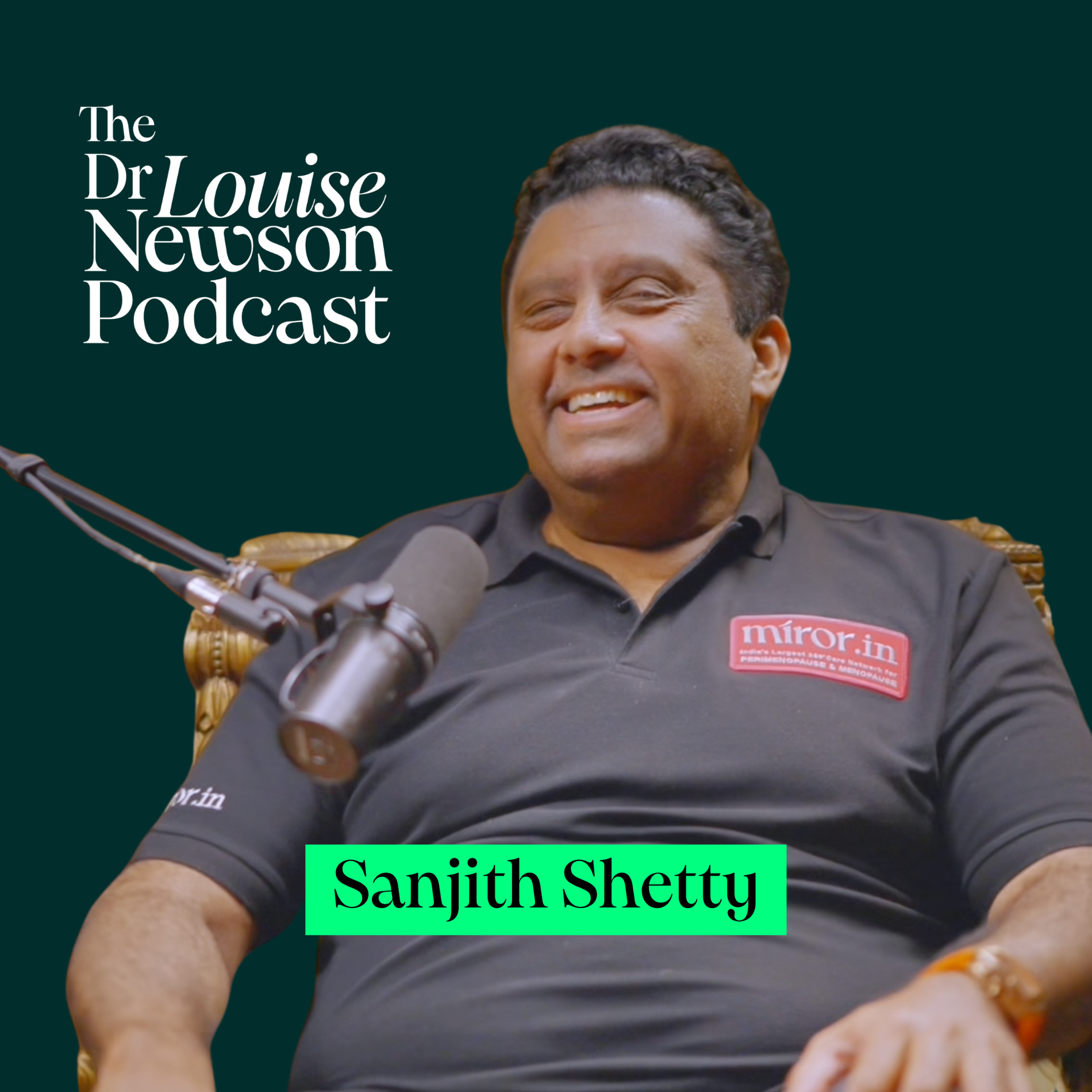
Official cover for Episode 96 · The Dr Louise Newson Podcast × Sanjith Shetty, founder of Miror
The four threads are why doctors fear HRT, how silence consumes women’s careers and confidence, how a community grows, and Shetty’s three wishes for India over the next five years. Each is explored below.
Chinese readers have good reason to listen closely: the training gaps, workplace silence, and lack of corporate involvement that India faces closely resemble our own situation, expressed in another language and healthcare system. Looking at India as a mirror can make it easier to see the issues people here feel too uncomfortable to raise.
Two: Why Doctors Fear HRT
Part Two: Why Doctors Fear HRT—A Misread History That Has Crossed Borders for Twenty Years
The episode’s most chilling moment is the doctor answering “Over my dead body” when a woman asks about hormone therapy. Shetty traces it to a misread history, one that is not limited to India.
🎙 Louise Newson, host
I often encounter similar confusion in Britain: many Indian doctors seem afraid to prescribe HRT. Why is that?
💬 Sanjith Shetty, guest
The root is a misread history. The famous WHI study in 2002 included older women who had been postmenopausal for years, using treatments that were not today’s bioidentical hormones. Yet its conclusions were simply extrapolated to everyone, embedding the fear that hormones mean danger.
How did that fear pass down through the years? It can be separated into a clear chain:
1 WHI 2002: participants had an average age of 63 and most were more than 10 years past menopause. They used nonbioidentical regimens such as conjugated estrogen plus medroxyprogesterone acetate.
↓
2 Simplification by the media and guidelines: “Hormones cause cancer and stroke.” Complex conclusions from later analyses could not outrun a slogan.
↓
3 Entry into medical education: misinterpretations settled into textbooks and prescribing habits, passed from one generation to the next.
↓
4 Transmission across borders to India: an American study from 2002 still influenced Indian doctors’ prescribing decisions in 2026.
↓
5 The result: only about 20% of Indian gynecologists had systematic menopause training → “Over my dead body.”
Three aspects deserve closer examination. First, a mismatch in the study itself: older age, late initiation, and nonbioidentical treatment were applied to everyone. Second, inappropriate extrapolation: later reanalyses generally identify extrapolation, rather than hormones themselves, as the problem. Third, cross-border transmission: Newson in Britain and Shetty in India encounter the same wall. These are the structural causes behind “Over my dead body.”
This fear is not unique to India. Britain’s NICE guidance and Newson Education’s Confidence in Hormones course aim to address doctors’ reluctance and lack of prescribing knowledge. The training gap is global; in India, the influence of WHI misinterpretations has persisted across more generations. Correcting the misunderstanding means breaking the question down: for whom, at what time, with which regimen, and monitoring which indicators? Evidence-based care means enabling appropriate treatment and excluding unsuitable candidates, rather than keeping everyone out with a slogan.
What is the appropriate approach? The episode offers no binary answer to whether hormones should be used. It reframes the question as who should use them, when, and with what monitoring. This is also the logic of the literature discussion below: the WHI is not overturned but placed back within its proper scope. Findings applicable to older women starting treatment late should not automatically cover women newly entering perimenopause, with substantial symptoms and a more favorable benefit–risk balance. Once research is returned to its boundaries of applicability, blanket fear loses its footing.
“Over my dead body.”
The doctor’s answer when a woman asked about HRT
— A real anecdote recounted in the episode

This sentence needs to be understood as more than one doctor’s loss of composure: it reflects a cultural reflex. What underlies it is not hormones themselves, but an interpretation of evidence that has not been updated. The episode repeatedly returns to reassessment through a timing window and individualization, rather than blanket refusal; see the literature discussion below.
Three: Silence Consumes Careers and Confidence
Part Three: How Silence Consumes Women’s Careers and Confidence—Brain Fog, Not Just Hot Flushes, Is Underestimated
If fear of prescribing HRT blocks the supply of care, silence quietly erases demand—and its effects extend far beyond health.
🎙 Louise Newson
What does that silence actually cost?
💬 Sanjith Shetty
Careers and confidence. Hot flushes, brain fog, and mood changes cause many experienced women to leave quietly. In one survey,
85%
said menopause had almost never been discussed seriously at work,
more than 50%
said symptoms affected their productivity,
71%
felt unsupported, and more than half had
never consulted a gynecologist about menopause
.
| 85% said menopause was almost never discussed seriously at work | 71% felt unsupported in the workplace | 50%+ said symptoms affected productivity; more than half had never consulted a gynecologist about menopause |
|---|
What undermines a career is often not hot flushes but brain fog, declining concentration, anxiety, and loss of confidence.
These changes are invisible, yet they directly weaken an experienced woman’s presence and decision-making at the meeting table. When she starts wondering, “Am I too old? Am I no longer capable?”, silence inflicts a second injury: her story about herself gives up before her body does.
The costs ultimately appear on the balance sheet. In its outreach to companies, Miror translates retention into language employers understand: replacing an experienced female leader costs roughly 1.5–2 times her annual salary. Businesses begin to act when menopause-friendly practices move from a charitable narrative to one about return on investment. This explains why Shetty insists on engaging employers: women should not bear the costs of silence alone.
The phrase quiet quitting recurs throughout the episode. Here, it means not submitting a resignation but quietly lowering ambitions and letting opportunities go. When brain fog leaves someone struggling to respond in a crucial meeting, or anxiety makes her avoid speaking on subjects she once handled confidently, her career is rewritten through repeated decisions to step back. The loss is almost silent: HR systems do not record menopause as the reason for departure, only a succession of entries marked personal reasons. By the time an organization notices fewer experienced staff, it is often too late.
For women themselves, the cost is less visible and more important: it erodes the underlying conviction that “I can still do this.” Many had never doubted themselves before symptoms gradually wore their confidence away. Looking back, they find they no longer dare to compete or wish to be seen. The episode’s claim that silence consumes confidence is not merely rhetorical. It describes a causal chain that can be measured and deserves intervention.

Four: How a Community Grows
Part Four: How a Community Grows—From 439 Femtech Companies to Open Conversation Among 75,000 Women
The episode’s third thread follows a male ally turning a personal experience into collective awareness.
💬 Sanjith Shetty
I studied
439 femtech companies
and found something absurd: compared with pregnancy, childbirth, and menstruation, menopause—a phase everyone goes through—had almost no support. More directly, I watched my mother and wife struggle through perimenopause, receive contradictory advice, and fail to find adequate help.
There are two layers to this starting point. The first is a market blind spot: pregnancy and menstruation have established products and services, while menopause, something everyone experiences but nobody discusses, has long remained neglected. The second is personal motivation: the real difficulties faced by his mother and wife drew an entrepreneur from outside the field into it. From research to action, Miror developed as follows:
① Research into 439 femtech companies → recognition of almost no support for menopause, a universal life stage
↓
② Personal experience: his mother’s and wife’s perimenopausal difficulties become the starting point for the business
↓
③ The Miror community: 75,000+ women discussing symptoms openly, across approximately 25 languages
↓
④ Technology: AI and wearable symptom tracking turn “something feels wrong” into recordable data
↓
⑤ Institutions: clinics in Maharashtra, training for 3,000+ ASHA frontline health workers, and India’s first HRT center of excellence
Why does the episode repeatedly emphasize community? Because it translates shame into evidence. When 75,000 women publicly describe similar experiences, individual confusion becomes a collective voice that presses providers—doctors, pharmaceutical companies, and policymakers—to respond. Alone, someone may be dismissed as oversensitive; together, the experiences become a signal. ASHA workers, comparable to China’s village doctors or family-planning officers, identifying menopause-related signs in rural communities are crucial to closing the last-mile gap.
India’s linguistic diversity matters. Coverage in approximately 25 languages means silence is sealed away separately within different dialects and cultures. For a community to work, it must be localized rather than confined to an English-speaking elite. Miror’s corporate outreach reinforces the point: translating retention into the language of employer ROI is more effective than moral appeals. Awareness confined to cities and highly educated groups creates ripples rather than a tide.
Miror’s decision to treat corporate outreach as a distinct activity shows that women helping one another is not enough. Silence has systemic roots, and its remedy must also be systemic. When employers pay for retention and governments put ASHA training on the public health agenda, change moves from individual courage to institutional momentum.

Five: Three Wishes
Part Five: Shetty’s Three Wishes for India’s Next Five Years—Knowledge, People, and Systems
The episode ends with three actionable wishes rather than a reflection alone. They correspond to three levels of change.
💬 Sanjith Shetty
My three wishes for the next five years are collaboration with global partners such as Newson, many more women joining communities at scale, and coordinated action by healthcare, government, and business. I believe that day is not far away: political parties will also begin supporting women in menopause and perimenopause.
1 Collaborate with global partners: knowledge. Bring evidence-based training from experts such as Newson, including Newson Education’s Confidence in Hormones course, to India, first addressing the skills gap behind doctors’ reluctance to prescribe.
2 Bring women into communities at scale: people. Help more women emerge from silence and talk openly, turning shame into collective evidence. This is how the community of 75,000 can continue to grow.
3 Coordinate healthcare, government, and business: systems. Isolated initiatives are insufficient; institutional cooperation is needed. Shetty even anticipates political involvement in menopause issues.
Knowledge: collaborate with global partners
→
People: women join at scale
→
Systems: healthcare, government, and business act together
Together, these wishes form a roadmap from the individual to the system: first sound knowledge, then enough people speaking up, and finally cross-sector systemic change. It is both an aspiration for India and something close to a replicable operating guide for menopause awareness.
Seen together, the three wishes form a supply–demand–institutions triangle. Knowledge addresses doctors’ lack of skills; the scale of participation addresses women’s reluctance to speak; coordinated systems address the sense that speaking makes no difference. Without one element, the others can come to nothing. This explains why Shetty places unified action last while viewing it as the hardest and most important part. Without institutional support, the first two wishes can remain emotionally moving without producing lasting change.
Six: Practical Takeaways
Part Six: Six Points Worth Taking Away from This Episode
1 Menopause is a public health and talent issue, not simply a private matter. Treating it as a test of personal endurance conceals systemic gaps.
2 Gaps in physician training are the central bottleneck. About 20% of Indian gynecologists have received menopause training. China has no precise comparable census, but the absolute number of menopause clinics and certified practitioners likewise falls far short of demand. This indirectly supports the wider nature of the gap: it concerns a chapter long missing from medical education, rather than an individual doctor’s failings.

3 Communities translate shame into evidence. A collective voice of 75,000 women discussing symptoms publicly puts more pressure on providers than isolated efforts.
4 The workplace offers particularly good value as a point of intervention. Replacing an experienced female leader costs about 1.5–2 times her annual salary. Businesses start acting when menopause-friendly practices are framed in terms of ROI rather than charity.
5 Frontline health workers enable access beyond major centers. India’s ASHA workers are comparable to China’s village doctors or family-planning officers and are essential to closing the last-mile gap.
6 Fear of HRT originates in outdated research interpretations. Reassessment needs a treatment window and individualization, rather than blanket refusal; see the literature discussion below.
7 Do not idealize or demonize dietary estrogen supplementation. Plant foods contain only phytoestrogens—weak-binding substances with SERM-like activity—and cannot replace MHT. Eating them as though they were natural hormones is an easy trap to fall into. See this publication’s subsequent article, “Can Soy Isoflavones Really Replenish Estrogen?”
Seven: Interpreting the Literature
Part Seven: Related Literature—A Quick Read for Clinicians
The repeated references to misread research can be separated into the following evidence chains. Their purpose is not to endorse HRT/MHT, but to turn fear back into evidence that can be discussed—the part clinician readers most need.
① Women’s Health Initiative (WHI) Hormone Therapy Trial, 2002, JAMA
This is the source of the fear discussed throughout the article and industry. Most participants were over 60 and many years past menopause, and nonbioidentical preparations such as conjugated equine estrogen were used. Findings of increased risk were extrapolated to every age and formulation. Later reanalyses generally point to extrapolation itself as the problem, rather than concluding that hormones themselves are dangerous.
② The Timing Window / “Timing Hypothesis,” Manson JE et al., 2013
The key conclusion is that initiating MHT before age 60 or within 10 years of menopause offers a more favorable benefit–risk balance. Later initiation, especially with existing cardiovascular disease, presents a different risk profile. This directly challenges the mistaken claim that hormones must never be used once menopause occurs.
③ Reanalysis Evidence: Early Initiation Does Not Increase, and May Reduce, Cardiovascular Events, While Protecting Bone Density
Indian media cite clinical views that early MHT initiation in appropriate candidates can protect bone density without promoting, and possibly reducing, cardiac plaque formation. The Indian Express also reports that approximately 1 in 100 women in India experience premature ovarian failure or early menopause; these groups have an especially strong need for appropriate hormone replacement.

④ Babbar K, Singh V, Sivakami M. Rising premature menopause and variations by education level in India. Sci Rep 14, 18238 (2024)
This Indian study suggests that premature menopause is becoming more common in India and is associated with educational level. At the epidemiological level, it supports early screening and recognition, echoing the episode’s rationale for ASHA workers conducting screening in communities.
⑤ Indian Menopause Society (IMS) 2026 Clinical Guidelines
These guidelines explicitly describe menopause as affecting cardiovascular, metabolic, skeletal, neurocognitive, and genitourinary systems, emphasizing that attention should not depend on the presence of hot flushes. This aligns with the positions attributed to global guidelines, including ACOG, BMS-NICE, and ACP: MHT as first-line treatment, stratified nonhormonal options, and individualized shared decisions.
Note: wearable hormone-tracking devices such as Clair mentioned in the episode and reports are commercial products. This publication cites them only as technology trends, not product recommendations. Claimed accuracy should be assessed against regulatory approvals and independent validation.
Eight: Implications for China
Part Eight: Three Implications for China
- Public discussion has expanded, but institutions remain underdeveloped. In China, widely circulated content includes Li Jing’s Invisible Menopause and the video podcast Healthy Jing Distance, whose two episodes reportedly received 150 million views. Yet almost nobody systematically develops menopause-friendly corporate policies. This is an opportunity for coverage and action.
- Frontline screening offers a model to adapt. India uses ASHA workers to reach communities. China could consider village doctors, family-planning officers, and community nurses for initial perimenopause assessment, extending capabilities concentrated in specialist clinics to county-level areas.
- Keep medical terminology and framing consistent. Whether discussing India or China, use MHT, often called HRT in the United States, and keep the focus on informed choices, bringing information to appointments, and shared decisions with a doctor.
- Medical education needs to add this chapter. India’s figure of approximately 20% receiving training reminds China to include perimenopause in routine gynecological and general-practice assessments, rather than relying on isolated menopause clinics. This is a prerequisite for closing the gap structurally.
This publication’s statement of scope:
This article analyzes a podcast and provides public education.
It does not provide a diagnosis, treatment advice, or recommendations for any product or brand
. Hormone treatment is referred to consistently as MHT, often called HRT in the United States. The specific regimen must be decided with the treating clinician in light of your medical history, risks, and preferences. Miror is a commercial entity; its published figures and product claims should be assessed critically.
Alternative Titles
Alternative Titles for Awei
- This Podcast Helped Me Understand Why Indian Women Have Endured in Silence for So Long
- “Over My Dead Body”: A Doctor’s Answer When a Woman Asked for Hormone Therapy
- What 75,000 Indian Women Talking Openly About Menopause Can Teach Us
- HRT and a Misconception Across Borders: A Podcast on Menopause in India and China
- Menopause Is a Talent Issue, Not Just a Private Matter: A Podcast That Breaks the Silence
Sources
Sources and Further Reading
① The official page for The Dr Louise Newson Podcast #96, 2026-08-27, including YouTube video wO8q_Tvv1oU; ② Podcast Rex / radoxo episode transcript highlights; ③ The Hans India / Businessworld / This Week India / The CSR Universe reports on Miror; ④ Indian Express, “India’s Menopause Moment,” an in-depth report including the Chopra survey, Clair data, and market size; ⑤ Truworth Wellness corporate policy framework; ⑥ The Health Worker analysis of workplace policy, citing Babbar et al. 2024, Sci Rep; ⑦ evidence-based literature including WHI 2002, JAMA; Manson 2013 on the timing hypothesis; and IMS 2026 guidelines.
· This publication focuses on evidence-based education about health and menopause for women over 40.
This article analyzes a podcast and provides public education.
It does not provide a diagnosis, treatment advice, or product recommendations
; hormone treatment is referred to consistently as MHT, often called HRT in the United States. Decide on any specific regimen with your treating clinician—
informed choices, bringing information to appointments, and shared decisions with a doctor
.
The episode cover is the official illustration for The Dr Louise Newson Podcast #96, used solely to identify the episode. Images in the body are explanatory infographics based on the episode’s public content, for identification and educational reference only.
Read the source material
- World Health Organization: Menopause and access to care
- NICE: Patient experience and communication CG138
- Advertising Standards Authority: Recognising social media advertising
The original archive manuscript is restored above. These additional references offer context; their inclusion does not constitute medical validation of every original claim. Clinical and regional terminology review are pending.
A good question starts a conversation.
Explore a related editorial discussion. Reading is open to everyone; posting and replying require a free reader account.
More from the library
 Community & information · 14 MIN READWomen Overseas Are Speaking Openly About Menopause. Why Are We Still Enduring It in Silence?↗
 Community & information · 15 MIN READWorld Menopause Day Beyond a Theme: Ten Years of Priorities and Unfinished Work↗
 Community & information · 13 MIN READInternal Wellness: Turning Real Health Needs into Evidence-Based Care↗