AI and Digital Technology in Women’s Menopause Health Management: An In-Depth Research Report
Organising notes, explaining terms and preparing questions can be useful tasks. Diagnosis, prescribing and urgent decisions need dependable clinical pathways.

In this article
Report type: Professional research report / evidence review (for clinician readers and industry observers). Search date: Main literature through 2026-10-27; additional checks of Chinese tool functions on 2026-11-01. Scope statement: This report reviews the current technical and evidence landscape. It does not constitute diagnosis, treatment advice, or a recommendation of any product. Commercial products are cited neutrally as “representative facts,” not as endorsements by this publication.
Executive summary
Menopause care has long faced a structural “data gap”: there is no single diagnostic gold standard, diagnosis depends on symptom patterns and highly variable FSH, patients experience vague symptoms and rely on memory, and clinicians lack time and continuous objective baselines, leaving management dependent on trial and error. The IMS 2026 World Congress on Menopause made “applications of artificial intelligence in women’s menopause health management” a distinct theme, covering digital symptom screening, assisted diagnosis and treatment, and group medical visits to expand access—marking a shift from “consumer health tracking” to a “clinical digital ecosystem.”
Using a three-layer architecture of hardware, algorithms, and clinical care, this report reviews developments alongside 2026 systematic reviews, the EMAS 2026 position statement, group-visit RCTs/service evaluations, and market-size data to assess trends and risks over the next 5–10 years. Its central judgment is that the most dependable value today lies in making symptom records, risk stratification, and follow-up auditable, reviewable, and transferable, rather than having algorithms replace clinicians.
How to read this report
Numbers in this report fall into three categories: clinical research data (describing outcomes or feasibility), technical validation data (describing model performance on particular tasks), and commercial market estimates (describing scale or expected growth). Their denominators, study designs, and generalizability differ, so they cannot be compared on one “effectiveness ranking.” Metrics from company materials or commercial reports are described as “the report states” or “public materials state” and flagged as pending independent verification.
Research design and evidence boundaries
1. Research questions
This report addresses four questions:
- Which digital technologies reliably collect menopause-related signals and translate them into understandable symptom or risk measures?
- Have these tools demonstrated improvements in symptoms, adherence, access to care, or clinical workflows?
- Which AI performance and scale figures in current marketing represent clinical evidence, and which are merely technical or commercial signals?
- Under Chinese regulation, privacy rules, and service systems, how should responsibilities be divided among “tools, licensed institutions, and patients”?
2. Search and inclusion scope
The search covered peer-reviewed papers, guidelines/position statements, clinical trials and service evaluations, regulatory digital-health documents, and traceable public product and market materials published from January 2020 to October 2026. Keyword combinations included menopause/perimenopause, wearable/digital phenotype/digital therapeutics, AI/machine learning, virtual group consultation, and clinical decision support. Priority was given to systematic reviews, randomized or controlled studies, prospective validation, and real-world implementation research. Single-vendor white papers and media reports were used only as background, not to establish treatment efficacy.
3. Evidence hierarchy and limitations
| Evidence level | Main purpose | Use in this report | Conclusions it cannot establish |
|---|---|---|---|
| Guidelines/position statements | Define care principles, risk boundaries, and implementation requirements | Constrain clinical and compliance judgments | Cannot establish that a particular app or model is effective |
| Systematic/scoping reviews | Summarize study numbers, signal types, and shared gaps | Assess field maturity and heterogeneity | Results of included studies cannot be treated as one effect estimate |
| RCTs/prospective validation | Assess symptom, behavioral, or workflow outcomes | Support cautious descriptions such as “potentially effective/feasible” | Cannot automatically generalize to every population and device |
| Observational/qualitative studies | Understand experiences, adherence, equity, and implementation barriers | Explain why users adopt or abandon tools | Cannot establish causation |
| Industry reports/vendor materials | Understand market size, product directions, and hypotheses needing validation | Present commercial signals separately | Cannot replace clinical effectiveness evidence or regulatory authorization |
Nordic forest vegetation | Photography:
Unsplash photographer
,
Unsplash License
Data interpretation principle: examine study design first, then outcome measures, then the applicable population. “Accuracy” has no independent meaning apart from task definition, threshold, validation set, and baseline.
1. The underlying problem: a “diagnosis and management gap” between patients and clinicians
1.1 The patient side
- Symptoms are highly heterogeneous and overlapping (hot flashes, insomnia, mood fluctuations, joint pain, brain fog, changes in desire), often attributed to “getting older,” “stress,” or thyroid, depressive, or cardiovascular problems;
- Episodes are intermittent and recalled from memory, while limited consultation time (an average of 3–5 minutes in China) cannot accommodate reliable longitudinal self-report;
- A culture of “putting up with it” and stigma lead many women to endure symptoms until bone loss and cardiovascular risk have accumulated for years before seeking care.
1.2 The clinician side
- Menopause education has long been lacking: US research suggests <10% of internal medicine, family medicine, or obstetrics and gynecology residents “feel prepared” to manage menopause after graduating;
- There is no single diagnostic gold standard; FSH fluctuates greatly in perimenopause, limiting the value of one blood measurement;
- Objective follow-up measures are lacking to determine whether an initial regimen works or a dose needs adjustment. “It seems a little better” is the most common and least reliable feedback.
The nature of the gap: Patients and clinicians lack a 24/7 passive, objective data layer between them. Wearable IoT sensors plus AI algorithms offer a technical route to fill it—not replacing clinicians, but translating what is “invisible, hard to explain, and hard to remember” into a clinical language shared by patients and professionals.
2. Technical layers: hardware, algorithms, and clinical care
| Layer | Role | Representative capabilities |
|---|---|---|
| ① Wearable hardware | Passive physiological acquisition | Skin temperature, electrodermal activity, HR/HRV, sleep staging, activity, continuous glucose |
| ② AI software | Pattern recognition + staging + quantification + reporting | Symptom clustering, phenotyping, trend prediction, shared patient–clinician reports |
| ③ Clinical layer | Data → decisions | Decision-support plugins, remote/group visits, individualized MHT planning |
Evidence-readiness framework (Women’s Health Wearables, Bioengineering 2026): Women’s health wearables should be assessed beyond sensor precision, meeting a V3 framework encompassing technical/physiological validity, clinical validity/utility, equity, workflow integration, and lifecycle monitoring, with validation intensity and escalation monitoring matched to “intended use.”
3. Current developments by module
3.1 Digital symptom-screening and tracking apps
The market has moved from “basic diaries” toward tools “built for clinical handoff”: - Flo for Perimenopause (2025): personalized guidance + symptom tracking + a “perimenopause score”; - Menotracker (2026): AI-driven, privacy-first architecture, covering 177 countries and 41 languages, producing “clinician-readable reports”; - mySysters, Balance (Newson Health), Caria, Midi, and others form a tiered ecosystem.
Evidence of empowerment: A 2023 qualitative study found 72% of users rated apps positively, with themes of “empowerment, self-reflection, and greater confidence communicating with clinicians.” Many women said they had felt dismissed when clinicians attributed symptoms to “anxiety or depression”; app data helped them reopen the conversation.

A Nordic forest path | Photography:
Unsplash photographer
,
Unsplash License
3.2 Digital therapeutics (DTx) and CBT
- MENO! App (Sidekick Health): CE-certified, using CBT for menopausal symptoms; launched a 12-week clinical study in Germany in 2025;
- Stella (Vira Health): FDA-cleared, 12 weeks of structured CBT + coaching;
- MenoMood (a digital therapeutics app approved by the FDA in 2023-06): CBT techniques reduced mood symptoms by approximately 35% over 12 weeks;
- Evaluations of Health & Her / Caria suggest reductions in hot-flash distress and combined depression/anxiety/sleep symptoms.
3.3 AI prediction and phenotyping
According to a market research report (Market Intelo), AI trained on a dataset of more than 850,000 patients can: - predict hot flashes 2–3 hours in advance with 87% accuracy, supporting proactive cooling or medication timing; - analyze 340,000 symptom logs to identify 23 distinct menopause phenotypes, enabling algorithmic “treatment–phenotype” matching; - use NLP to analyze unstructured symptom accounts with “clinical-grade precision”; - automatically identify skin flushing through computer vision (91% sensitivity), removing the need for active user logging; - flag patterns requiring clinical escalation through predictive analytics (94% sensitivity for depression risk in menopausal populations). - Regulatory precedent: In Q2 2026, the first “autonomous AI diagnostic system for assessing menopause severity” received FDA clearance, accelerating subsequent AI integration.
Academic reviews caution, however, that these commercial metrics lack independent peer-reviewed validation. AI capabilities are limited by scarce labeled real-world data (see Section 4).
3.4 Wearable monitoring and digital phenotypes
- Oura Perimenopause Check-In (2025) + Maven Clinic: its ovulation-detection algorithm reduced error for irregular cycles from 6.63 days with calendar methods to 1.48 days (96.4% accuracy). Data suggest perimenopausal women lose up to 2 hours of sleep weekly and HRV falls 20–30% in early/late stages;
- Apple Watch (heart-rate/arrhythmia alerts, relevant to a postmenopausal population with 2–3× cardiovascular risk), Embr Wave (wrist-based warming/cooling), IdentifyHer “Peri” (CES Digital Health Innovation Award, an under-breast biosensing patch using AI to decode hot flashes/night sweats/anxiety), and continuous glucose monitoring (CGM) (a “sleep–stress–food–glucose” map as falling estrogen → reduced insulin sensitivity).
- Digital phenotype framework (PMC 2026): a move from “counting hot flashes” to identifying clinically meaningful phenotypes—nighttime vasomotor symptoms, sleep interruption, stress-reactive symptom flares, failed recovery after poor sleep, and fatigue-related activity reduction—to guide behavioral and treatment adjustments.
3.5 Telemedicine and virtual clinics
- Midi Health (completed a $50 million Series C in 2025, serving approximately 20,000 women weekly, with mainstream insurance coverage), Evernow (celebrity endorsements), Alloy (reported 62% year-on-year growth in 2026-04 through an app + direct-delivery HRT + clinician oversight), Winona, HerMD;
- Institutionalized employer benefits: By mid-2026, 56% of Fortune 500 companies offered menopause-specific benefits (only 8% in 2021);
- A payment turning point: UnitedHealth included DTx devices for menopause symptom management in coverage in 2025, adding 18 million members overnight—a shift from “entirely self-pay” to “payer subsidy,” improving accessibility and affordability.
3.6 Group Medical Visits / Virtual Group Consultations (VGC)

A misty Nordic forest landscape | Photography:
Unsplash photographer
,
Unsplash License
Consistent with one of NAMS 2026’s five major updates (expanding access through group visits): - NEJM Catalyst (2022, Bia Care / NHS London): VGC with 25 participants, 52% improvement in MENQOL scores (55% psychological, 63% sexual); 18/25 were from minority ethnic groups/the most deprived areas, demonstrating equitable access; - BMJ SRH (2026): Primary-care virtual groups, 351 referrals over 5 months, 86% utilization, nonattendance reduced from 26% to 10%, 100% positive patient feedback; - Birmingham (2026, military population): A series of five 90-minute group sessions, average confidence +45%, reduced symptoms, and positive effects on employer engagement and retention.
3.7 Clinician decision support
- MENO.pause (UCLH, launched 2025-07): translates NICE/BMS/BGCS guidance into stepwise consultation support, directly embedded in hospital information systems such as EMIS, free for NHS users;
- MenoPro (NAMS): patient/clinician modes, risk calculators, and collaborative decisions.
- Value proposition: addressing the gap of “clinicians not feeling able or knowing how to act” tackles the underlying issue more directly than pouring resources into consumer education.
4. Current academic evidence: a critical review
- Sensors & AI scoping review (Kuduza et al., Maturitas / EMAS 2025 special issue, 2026): 81 papers retrieved, 58 studies included. Technologies were varied (skin/thermal/cardiovascular/activity/EMG/EEG/PSG/environmental sensors), but the conclusion was cautious: clinical interpretation remains limited; the focus is on hot flashes and night sweats; environmental influences are underexplored; datasets are small and inconsistent; and AI is constrained by scarce labeled real-world data.
- Apps & Wearables systematic review (ResearchSquare, 2025/2026): assessed 80 apps. 52.5% included AI features (symptom summaries, chatbots, personalized insights), but underlying models and validation processes were rarely disclosed. Only 4/80 (5%) reported peer-reviewed evidence of improved outcomes, and 2/80 (2.5%) had an RCT or planned RCT reporting. Natural Cycles was the only perimenopause-related tool to undergo formal regulatory review (FDA Class II).
- Consensus: Most tools remain at the stage of “empowering communication and structuring data,” with an evidence gap before independent diagnosis/treatment decisions. Multimodal, real-world, data-driven approaches are prerequisites for dependable personalization.
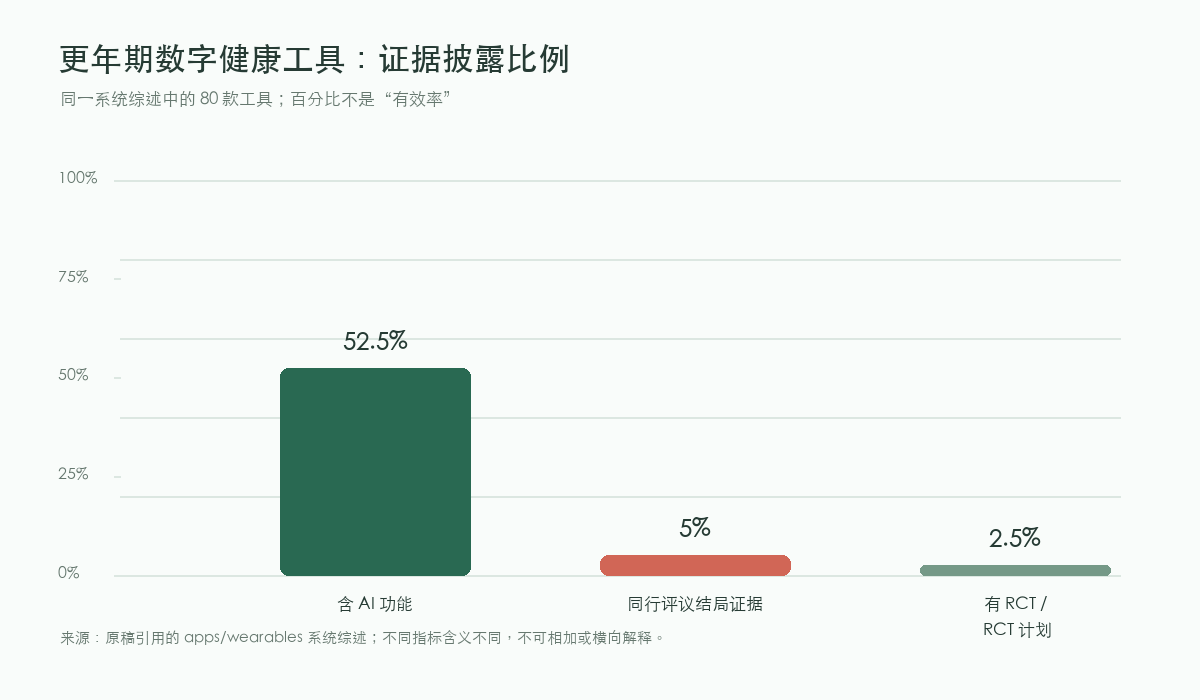
Data definition: The chart presents only one systematic review’s report on 80 tools, not the entire market. The 52.5% refers to tools claiming or including AI functions, 5% to tools reporting peer-reviewed evidence of improved outcomes, and 2.5% to tools with RCTs or RCT plans. The three percentages share a denominator but have different meanings; they cannot be interpreted as “the overall effectiveness rate of AI tools.”
5. Market and investment signals
Figures in this section come mainly from commercial market reports. They reflect investment and supply expectations, not patient benefits:
- Menopause app market: PW Consulting estimates $420.5 million in 2025 and $1,228.5 million in 2032, a compound annual growth rate of 16.55%.
- AI-powered menopause DTx devices: Public commercial materials claim that approximately 18% of menopause cases in developed markets use some form of DTx (approximately 3% in 2020), and approximately 31% of privately insured US women do. Samples, definitions, and sampling frames behind these proportions need independent verification.
- Femtech composition: Research Intelo estimates hardware (34.91B) > software (25.62B) > services (13.27B). These cannot simply be added to the app market size because market boundaries and currency definitions may differ.
- Fastest-growing segments: Public reports give CAGRs of 23.5% for AI-personalized treatment planning, 26% for employer/corporate health channels, and 23.8% for Asia-Pacific. These should be treated as scenario forecasts, not growth already achieved.

Cloud and mist over Nordic highlands and a mountain road | Photography:
Unsplash photographer
,
Unsplash License
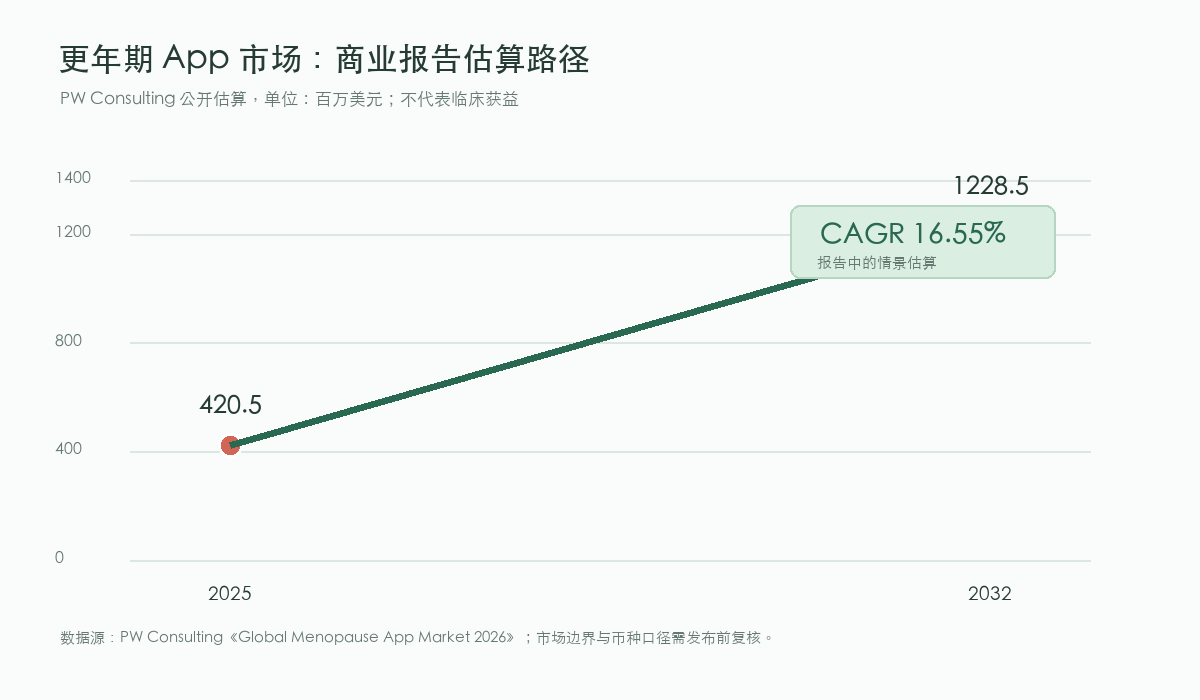
Data definition: This chart follows PW Consulting’s public estimates solely to show the report’s projected growth path. It is not a proxy for patient numbers, clinical need, or product effectiveness.
6. Future trends: the next 5–10 years
- From symptom diaries → a clinical handoff ecosystem: Apps integrate telehealth and pharmacy fulfillment (Midi/Alloy have demonstrated commercial traction), forming a “tracking–consultation–prescription–follow-up” loop.
- From single signals → multimodal digital phenotypes: Fusion of electrodermal activity + skin temperature + HRV + movement + sleep + self-report outperforms single signals (hot flashes can be jointly influenced by heat/exercise/anxiety/alcohol/sleep stage).
- From consumer-grade → regulatory-grade: FDA clearance, CE marking, and NICE alignment become entry requirements; V3/evidence-readiness frameworks standardize validation.
- AI-personalized treatment planning becomes the fastest-growing segment: Models based on more than 100,000 health records optimize MHT doses, predict symptom flares, reduce adverse events, and improve adherence.
- Group/virtual visits scale up: Address global specialist shortages (AAMC forecasts a US shortfall of 37,000 endocrinologists by 2034; UK specialist waits of 14 weeks in 2025, Canada/Australia 18–22 weeks).
- Employer benefits become institutionalized: A shift from fringe benefit to standard employee health provision expands access and reduces disability costs.
- Asia-Pacific (China) becomes the fastest-growing hub: Significant opportunity for a local “data bridge” (hardware + AI + licensed clinics); local hardware/AI products focused specifically on menopause remain scarce.
- Privacy-first architecture: On-device encryption + federated learning become research and development necessities (driven by GDPR / China’s PIPL), and privacy becomes the leading purchase factor.
6.1 From “performance numbers” to auditable clinical measures
Commercial materials often group hot-flash prediction, flushing detection, and depression-risk screening together as “accuracy.” Their task definitions, positive thresholds, time windows, validation sets, and costs of error are entirely different. A clinically suitable report should at least provide sensitivity, specificity, positive/negative predictive values, calibration, missing-data proportions, and performance stratified by population, alongside an explanation of who reviews cases when the model fails.
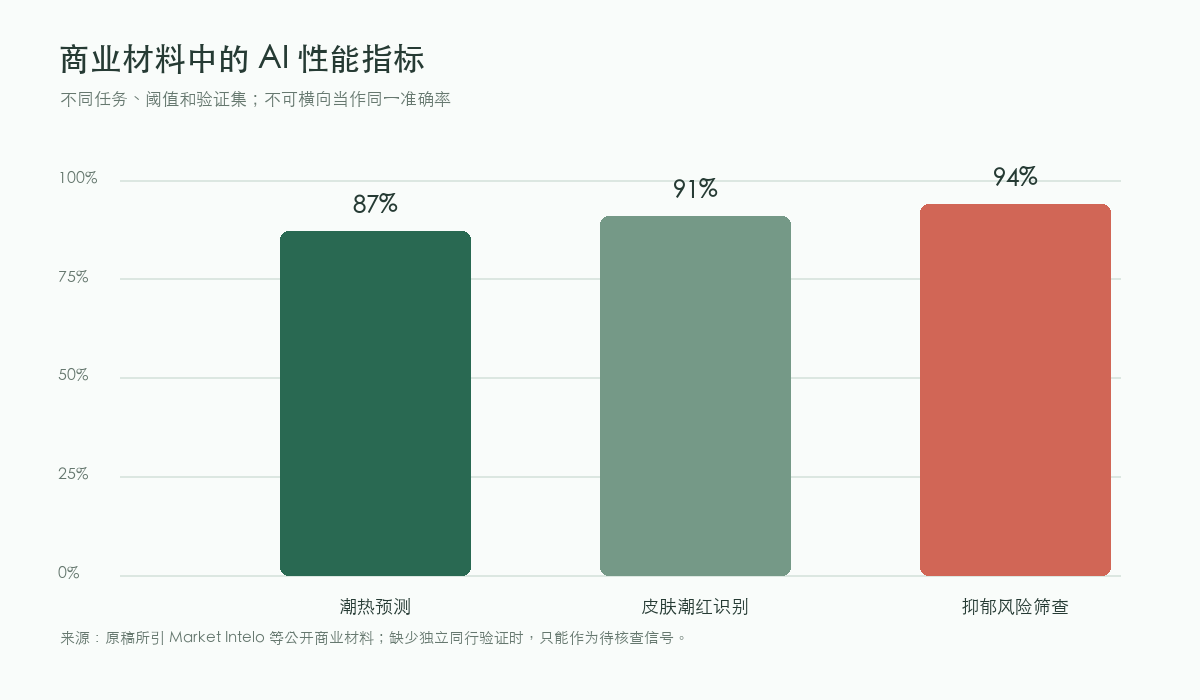
Data definition: The chart organizes commercial materials such as Market Intelo cited in the original draft. The 87%, 91%, and 94% correspond to different tasks and cannot be compared horizontally as the same accuracy measure, nor establish capacity for independent diagnosis or treatment.
6.2 A recommended clinical implementation pathway
| Stage | Main deliverables | Key validation question | Responsible parties |
|---|---|---|---|
| Discovery | Symptom diaries, wearable signals, user needs | Are the data complete and representative of the target population? | Product and research teams |
| Validation | Preregistered algorithms and prospective validation datasets | Is performance stable against clinical reference standards? | Researchers and clinical institutions |
| Pilot | Clinician-readable reports, triage or follow-up workflows | Does it reduce repeated questioning and improve adherence without increasing misleading information? | Healthcare institutions and licensed professionals |
| Scale | Real-world monitoring, equity audits, incident reporting | Is it safe across ages, skin tones, regions, and device conditions? | Companies, regulators, and healthcare institutions |
7. Challenges and risks: professional cautions
- Evidence quality: Small samples, inconsistent validation, and scarce labeled real-world data limit AI generalizability;
- Algorithmic limitations/bias: HRV has a weak and inconsistent association with symptom severity; single signals are easily misclassified (ambient heat, exercise, anxiety, alcohol, medication, sleep stage);
- Regulatory uncertainty: Boundaries for AI clinical decision support (SaMD) and remote HT prescribing rules continue to evolve;
- Commercial distortion: Some apps encourage non-evidence-based hormone testing (blood/urine), while excessive symptom focus can generate anxiety (JMIR 2026 warning), echoing Jen Gunter’s IMS 2026 theme “Menopause for Sale: Misinformation, Commercialization”;
- Clinical adoption gap: Insufficient primary-care training calls for standardized education, such as MENO.pause’s approach of embedding guidelines in information systems;
- Equity concerns: The digital divide—89% of rural/resource-poor areas lack menopause specialists. AI DTx may become the only feasible option, but “technological exclusion” must also be prevented.

Nordic highland grassland at sunset | Photography:
Unsplash photographer
,
Unsplash License
7.1 Minimum checks before publication
- Source check: Every number is traceable to a paper, registered study, regulatory database, or original market report; unverifiable figures are clearly marked.
- Task check: Distinguish screening, prediction, classification, and treatment outcomes. Do not describe technical performance as clinical benefit.
- Population check: State sample ages, perimenopausal stages, device models, missing data, and external-validation status.
- Risk check: Explain procedures for false positives, false negatives, data leakage, and automation bias.
- Update check: Set review dates for product status, regulatory status, and prices, avoiding presentation of historical information as current fact.
8. The Chinese context and local pathways
- Established front ends: Guangzhou Women and Children’s Medical Center’s “Geng Jiankang” mini program (launched 2025, upgraded to 2.0: AI symptom radar → personalized reports → education → outcome tracking → care navigation, a “screening–assessment–intervention–follow-up” loop, with nearly 500 assessments collected and 15 institutions in its collaboration network); Chinese menstrual-cycle apps had 140 million users in 2025 (36.8% of the global total), providing a user base for perimenopause functionality; ClouDr Health + Medici built a digital “consultation–medication purchase–follow-up” loop (Remifemin, covering 31 provinces and more than 200 cities).
- Regulatory constraints: Prohibition on initial consultations, no independent NP prescribing, red lines around public prescription-drug advertising, and health-data localization → a local approach of “lightweight tools + substantial compliance partnerships” is required. Hardware and AI provide pre-visit education and post-visit tracking, while diagnosis and prescribing remain with licensed clinics/internet hospitals; tools do not cross those boundaries.
- Public awareness: People’s Daily Health reported on wearables “winning over” female users. Dr. Kaufman at Johns Hopkins noted that data collected from around age 35 and learned at scale by AI could potentially predict multiple perimenopausal symptoms.
- Local opportunity: Education/screening tools exist, but a data loop that “returns assessment directly to clinical decision-making” is not yet reliably connected. Local hardware + AI products specializing in menopause remain scarce; that is the gap.
8.1 In China, how can individuals turn records into useful consultation information?
First choose a recording method convenient enough for long-term use. A phone can record menstrual changes, hot flashes, sleep, and medication responses. A watch can add sleep and heart-rate trends, but cannot directly measure “falling estrogen” or diagnose menopause. The following are examples of tools available to Chinese users, not a ranking of product effectiveness; functions may vary by device model, app version, and region.[20–23]
Record periods, hot flashes, and night sweats: You do not need to buy a device first. Record dates and changes in bleeding in phone notes, iPhone Health’s Cycle Tracking, or a menstrual app such as Meiyou. Separately note hot-flash timing, frequency, and effect on life. Bring several recent months of records to the consultation. Cycle prediction is not a diagnosis of ovulation, menopause, or pregnancy; ordinary menstrual apps may not have dedicated hot-flash fields.[20,22]
Record sleep and activity: Existing Apple Watch users can view relevant data in iPhone Health; Huawei watch/band users can review supported sleep, heart-rate, and other trends in Huawei Health. Choose screenshots covering a period relevant to the main complaint, noting whether awakenings accompanied hot flashes. Consumer sleep staging and HRV are not hormone tests; poor sleep can have other causes.[21,25]

Nordic snow-covered mountains and valley | Photography:
Unsplash photographer
,
Unsplash License
Record already monitored measures such as blood pressure: If blood-pressure monitoring is already needed, use a validated upper-arm electronic monitor with the correct cuff size, writing readings down or using its companion app. Give the clinician dates, times, readings, and medication details, not just an average. Menopause alone does not require routine purchase of continuous glucose monitoring; abnormal readings need confirmation through proper medical pathways.
Use AI for organization, not diagnosis: Phone notes or a spreadsheet can produce a summary. For help organizing it, a general AI question-answering tool such as Tencent Yuanbao is an option. Bring one page that you have checked yourself: the main complaint, symptom timeline, medications, and questions. General AI is not a menopause diagnostic tool and cannot replace a clinician’s interpretation of tests or advice about medication changes. Read the platform’s privacy rules first, enter only de-identified information, and do not upload ID numbers, original medical records, or identifiable photographs.[23]
Use official hospital entry points: If a local hospital offers digital assessment, find the mini program or internet hospital through its official channels, such as the “Geng Jiankang” project above. Give assessment results and past records to the clinician. Access for users outside the area and specific functionality depend on hospital announcements; a mini-program score is not a diagnosis.
A practical pre-consultation process: Record continuously for about 2–4 weeks first (without delaying care to wait for records), clearly noting “when it occurs, how long each episode lasts, whether sleep or work is affected, and whether periods have changed.” From existing watch data, choose trends corresponding to symptom timing rather than exporting every raw record. To use AI to understand symptoms, you could ask: “What conditions might involve hot flashes, nighttime waking, and menstrual changes? Explain in plain language, distinguishing guideline-supported information, uncertainties, and questions to confirm with a clinician. Do not diagnose me from my records.” Then enter records without identifying information and ask it to organize symptoms, medication, and missing information by date. Check every generated item and remove guessed causes or fabricated sources. Bring the summary, original records, and previous test results to the appointment, where the clinician decides whether further investigation is needed in light of the history.[20–25]
When not to wait for an AI conclusion: Bleeding after menopause, unusual heavy bleeding, sudden chest pain, or breathlessness should be assessed directly by a healthcare institution. Seek care promptly if symptoms already substantially affect daily life. Normal device curves cannot rule out disease, and a chat tool’s “low risk” answer cannot replace an in-person consultation.
9. Conclusion
AI and digital technology are reshaping menopause management from “one-off subjective judgment + trial and error” into “continuous objective data + algorithmic stratification + shared patient–clinician decisions + group/remote access.” Short-term value lies in filling the data gap, empowering communication, and expanding access. Over the medium to long term, multimodal digital phenotypes + regulatory-grade AI-personalized planning + group/virtual visits + employer/payer integration will define the next decade. This report’s evidence audit, however, indicates that the greatest current need is not “one more AI feature,” but prospective validation across devices, populations, and institutions, with a complete chain of responsibility. Only by addressing all five risks—evidence quality, algorithmic bias, regulatory boundaries, commercial distortion, and equity—can technological benefits avoid dilution by marketing noise. That is consistent with this publication’s established position of “the right to be informed + reducing anxiety + shared decisions with clinicians.”
References (main literature searched on 2026-10-27; product functions checked on 2026-11-01)
- Kuduza H, et al. Data-driven insights in menopause: A scoping review of sensors and AI. Maturitas (EMAS 2025 special issue). 2026. DOI: 10.1016/j.maturitas.2026.00254.
- EMAS Position Statement. 'Healthy menopause': precision, digital, and interdisciplinary midlife health. Maturitas. 2026. DOI: 10.1016/j.maturitas.2026.00237.
- Women's Health Wearables: From Continuous Signals to Actionable Digital Phenotypes Across the Reproductive Lifespan. Bioengineering. 2026;13(8):897. DOI: 10.3390/bioengineering13080897.
- The current state of apps and wearables for supporting peri/menopausal individuals: a systematic review. ResearchSquare. 2025/2026.
- Hayhoe BWJ, et al. A Virtual Group Consultation Model of Care for Menopause Treatment. NEJM Catalyst. 2022;3(6).
- Curran J, Margerison C. Improving access to menopause care through scalable virtual group consultations in primary care. BMJ Sex Reprod Health. 2026;52(Suppl 3).
- Delivering holistic menopause care through group consultations: a feasibility study in a military population. BJGP. 2026.
- Glauser W. Menopause Apps Offer Empowerment, but Pose Risks. JMIR. 2026;1:e106205.
- Market Intelo. AI-Powered Menopause Symptom Digital Therapeutics Devices Market Research Report 2034. 2026.
- PW Consulting. Global Menopause App Market 2026. (2025: $420.5M → 2032: $1,228.5M, CAGR 16.55%).
- Research Intelo. Menopause Health Technology Market Research Report 2034. 2026.
- FemTech World. Best menopause apps and products for 2026. 2026.
- Guangzhou Women and Children’s Medical Center “Geng Jiankang” mini program (public reports, 2025–2026); ClouDr Health × Medici digital care loop (Guangming Online, 2026-07-27); People’s Daily Health, “How wearable devices win over female users” (2025-11).
- World Health Organization. Global strategy on digital health 2020–2025. Geneva: WHO.
- U.S. Food and Drug Administration. Clinical Decision Support Software: Guidance for Industry and Food and Drug Administration Staff. 2022.
- NICE. Evidence standards framework for digital health technologies. Updated 2022.
- Liu X, et al. Reporting guidelines for clinical trials evaluating artificial intelligence interventions: the CONSORT-AI extension. Nature Medicine. 2020.
- Cruz Rivera S, et al. Guidelines for clinical trial protocols for interventions involving artificial intelligence: the SPIRIT-AI extension. Nature Medicine. 2020.
- Vasey B, et al. DECIDE-AI: reporting guidelines for the early-stage clinical evaluation of decision support systems driven by artificial intelligence. Nature Medicine. 2022.
- Apple Support: “Log menstrual cycle information in Health on iPhone”; records periods, symptoms, and spotting. https://support.apple.com/zh-cn/guide/iphone/iph51a822b18/ios (accessed 2026-11-01).
- Huawei Consumer Business: “Huawei Health”; the official page lists views for sleep, heart rate, menstrual cycles, blood pressure, and other data. https://consumer.huawei.com/cn/mobileservices/health/ (accessed 2026-11-01).
- Meiyou official website: the product began as a menstrual-tracking app. https://www.meiyou.com/ (accessed 2026-11-01).
- Tencent Yuanbao official website: an example of a general AI question-answering product; this article does not treat it as a medical diagnostic tool. https://yuanbao.tencent.com/ (accessed 2026-11-01).
- NICE guideline NG23: Menopause: identification and management; used to distinguish symptom recording from clinical judgment; implementation follows local medical standards. https://www.nice.org.uk/guidance/ng23 (searched 2026-11-01).
- Apple Support: “View your sleep history in Health on iPhone”; sleep data can be collected by compatible monitoring devices or added manually. https://support.apple.com/zh-cn/guide/iphone/iph72b370881/ios (accessed 2026-11-01).
(First drafted on 2026-10-27, with Chinese tool-use pathways added on 2026-11-01. For academic, industry, and health-education topic research; follow medical advice and consult licensed institutions for individual treatment and product choices.)
Read the source material
- WHO: Ethics and governance of large multi-modal models in health
- NICE: Evidence standards framework for digital health technologies
- NICE: Menopause identification and management NG23
The original archive manuscript is restored above. These additional references offer context; their inclusion does not constitute medical validation of every original claim. Clinical and regional terminology review are pending.
A good question starts a conversation.
Explore a related editorial discussion. Reading is open to everyone; posting and replying require a free reader account.
More from the library
 Digital health · 14 MIN READYour Watch Says “Luteal Phase”: Is That the Same as a Blood Hormone Test?↗
 Digital health · 10 MIN READWearables, Measurements, and Meaning: Women’s Health Data Across the Life Course↗
 Bone health · 16 MIN READPeriods Stopped Early: Should Bone Checks Start Early Too? Evidence on Early Menopause, POI, and Osteoporosis↗