MHT and Bone Health: How Estrogen Helps Bones Save for Life on World Osteoporosis Day
Bone density, fracture history and overall risk guide care. Bone protection is not a reason for everyone to use hormones.

In this article
Clinical highlights (for clinician readers)
Clinical highlights (for clinician readers)
- Disease burden: About 500 million people worldwide have osteoporosis; among people >55, approximately 70 fractures occur every 1 minute; about 1/3 of women over 50 will experience an osteoporotic fracture in their lifetime, and around 80% of fragility-fracture patients have never received follow-up intervention.
- Core mechanism: Estrogen is the “brake valve” of bone metabolism—after withdrawal, osteoclast activity increases and resorption exceeds formation, particularly in trabecular bone in the spine and hip. Bone loss is fastest during the first 5–10 years after menopause.
- WHI evidence (E+P): Cauley et al. (JAMA 2003, PMID 14519707, n=16,608) reported an all-fracture HR of 0.76 and hip BMD +3.7%; estrogen alone (CEE) yielded a hip-fracture HR of 0.61 and vertebral HR of 0.68.
- Consistent evidence: A meta-analysis of RCTs from 1973–2000 showed vertebral fractures ↓33% and nonvertebral fractures ↓27%; NORA (hip-fracture OR 0.60 among current users) and the Million Women Study (RR 0.62) offer corroboration.
- Authoritative position: NAMS 2022 (Faubion, Menopause 2022;29(7):767-794) explicitly states that MHT “prevents bone loss and fractures”; the benefit–risk ratio is more favorable at <60 years or <10 years since menopause, and transdermal/low-dose treatment can reduce VTE and stroke risk.
- Key boundary: MHT is a first-line option for “preventing loss and reducing risk,” but is not equivalent to antifracture treatment after osteoporosis has been diagnosed; patients with a fragility fracture or T-score ≤-2.5 need combined or alternative antiresorptive treatment according to guidelines.
In the consultation room, a 52-year-old woman slides her bone-density report across the desk: “Doctor, three years ago I was -1.8. How am I -2.6 now? I drink milk every day.” She is not unusual. We repeatedly see in clinic that women's bone mass does not decline at a constant rate around menopause: it can accelerate as though a floodgate has opened. World Osteoporosis Day falls on 10-20, and the 2026 theme deliberately places “for life” in its slogan: “Build, Protect, Strengthen Bones—for life.” It offers a timely opportunity to take a longer view of the relationship between MHT and bones.
One. Understanding the theme: why “for life” matters most this year
The International Osteoporosis Foundation (IOF) set the 2026 theme for World Osteoporosis Day (WOD) as “Build, Protect, Strengthen Bones — for life.” Those gentle-sounding words carry a firm reminder: bones are not organs to care about only in old age, but an “account” requiring lifelong management.
The “bone account” metaphor fits well. People reach peak bone mass around age 30, then enter a phase of “income and expenditure”: youth is mainly about depositing, while perimenopause begins a period of large “withdrawals.” For women, estrogen is the protective factor that helps bones “withdraw less and preserve more capital” at a critical time. Once its level drops sharply around menopause, resorption far outpaces formation and the account quickly runs low—this is the fundamental reason osteoporosis disproportionately affects women.
An often-overlooked comparison comes from space. Astronauts in microgravity may lose around 1%–2% of bone mass each month, making bone protection a required component of long-duration International Space Station (ISS) missions. Without intervention, postmenopausal women's annual rate of bone loss is strikingly similar. Juxtaposing these two forms of “weightlessness” is not intended to alarm, but to help patients grasp that estrogen withdrawal is, for bones, almost a form of “physiological weightlessness.”
“For life” is also a clinical reminder: the bone-protection window does not begin with an osteoporosis diagnosis. It should open at peak bone mass, in perimenopause, or when someone first hears that “estrogen is declining.” We often treat osteoporosis as an “old-age disease” and panic only after a fall and hip fracture; what can truly change outcomes is moving that conversation twenty or thirty years earlier. World Osteoporosis Day lasts one day each year, but its aim is to influence every woman's bone account on every day that follows.
To make the burden more concrete, describing a hip fracture as “the last fracture of one's life” is not simply alarmism: a substantial proportion of patients die within a year, and more than half cannot regain independent walking. This often begins with preventable bone loss. MHT cannot shield everyone from that blow, but among people for whom it is appropriate, it meaningfully reduces risk.

Jökulsárlón glacier lagoon, Iceland | Photograph by
Jakub Hałun
,
CC BY 4.0
.
Figure: World Osteoporosis Day 2026—the lifetime “bill” for bone health
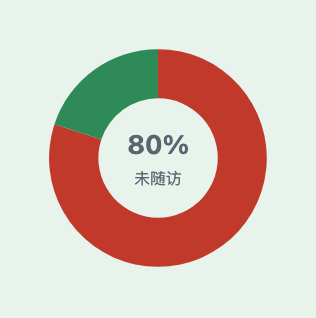
After a fragility fracture
80% have never received systematic follow-up
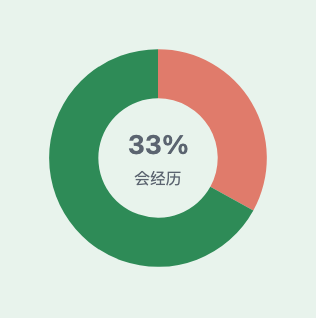
Women over 50
About 1/3 will fracture in their lifetime
~500 million
People worldwide with osteoporosis
~70 cases/minute
Fractures per minute among people >55
2–3%
Annual bone loss in the first 5–10 years after menopause
Source: IOF World Osteoporosis Day 2026 theme materials. Without follow-up after a fragility fracture, subsequent-fracture risk rises significantly—this is the gap “Fracture Liaison Services” aim to close.
A one-sentence background note for clinicians
Another meaning of this year's theme is the emphasis on “Fracture Liaison Services (FLS)”: after a fragility fracture, actively follow up, assess, and intervene, rather than “apply a cast, send the patient home, and never ask again.” Data show that about 80% of fragility-fracture patients have never received systematic follow-up, a major gap for healthcare systems to address.
Two. Mechanism: why estrogen withdrawal leaves bones “in deficit”
To explain why MHT can protect bones, we first need to explain what estrogen does within them. Put simply, estrogen has a dual role as a “brake valve” and a “mediator” in bone metabolism.
Bone is not dead concrete, but a dynamic balance between “demolition” and “construction.” Osteoclasts handle demolition (bone resorption); osteoblasts handle construction (bone formation). With normal estrogen levels, estrogen suppresses osteoclast precursor survival and activation, promotes apoptosis, and regulates various cytokines—for example reducing IL-1, IL-6, TNF-α, and RANKL while increasing OPG—keeping demolition in check. After the sharp postmenopausal fall in estrogen, this inhibition lifts, osteoclasts become active and “unrestrained,” and resorption substantially exceeds formation: trabeculae thin, break, and develop perforations, while cortical bone becomes thinner and more porous.
Different sites are affected at different speeds. The trabecular-rich spine and hip, with greater metabolic activity and surface area, are regions of particularly pronounced loss; this also explains why postmenopausal fractures most often occur at the vertebrae, hip, and wrist (Colles fractures). Studies consistently identify the first 5–10 postmenopausal years as an “accelerated phase,” with annual losses of 2%–3%, or more in some women. That raises a key clinical question: the timing of MHT may merit even more discussion than simply “whether to use it.”
Figure: bone-mass trajectories around menopause (schematic)
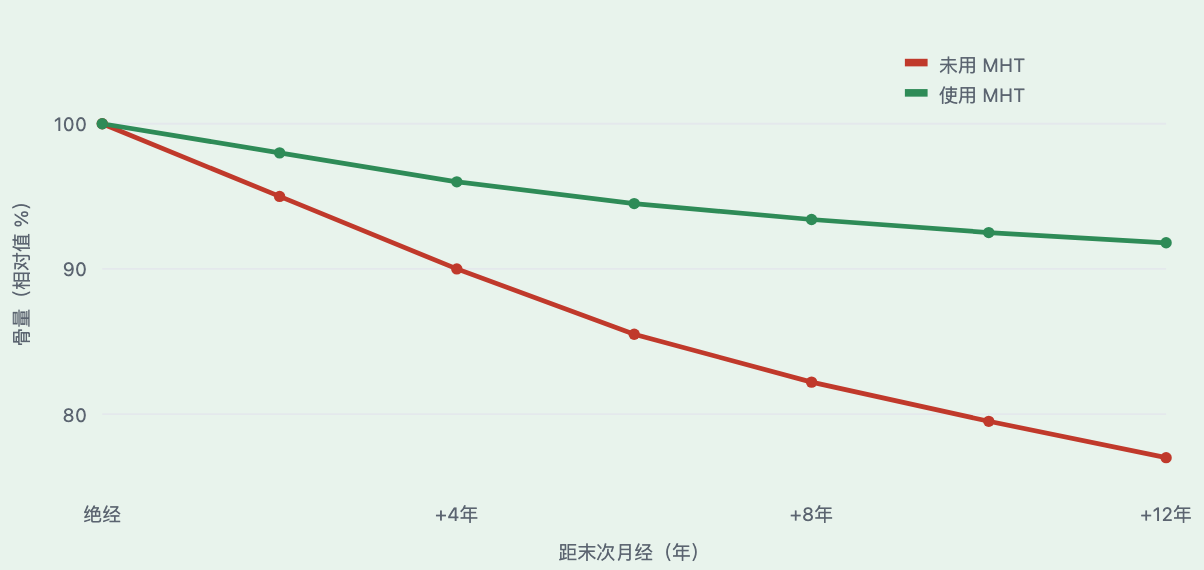
After estrogen withdrawal, resorption accelerates; without MHT, the curve falls sharply during the first 5–10 years (about 2%–3% annually), then slows; with MHT, it is markedly flatter. “0” on the horizontal axis marks the final menstrual period; the vertical axis represents relative bone mass. Values are illustrative; individual DXA findings take precedence.
Zooming in further, estrogen's bone protection centers on the RANKL/OPG axis. RANKL on osteoblasts and stromal cells “activates” osteoclast precursors; estrogen can upregulate its “braking ligand,” OPG, blocking RANKL. With estrogen withdrawal, OPG becomes relatively insufficient and RANKL gains the upper hand, recruiting more osteoclasts. Meanwhile, proinflammatory factors previously suppressed by estrogen, such as IL-1, IL-6, and TNF-α, rise again, further stimulating resorption. Understanding this axis explains why “taking calcium” alone cannot stop early postmenopausal loss: calcium supplies raw materials, while estrogen controls “how fast the factory walls are demolished.”
Another easily missed detail is that osteoporotic spinal fractures are often “silent.” A patient may only notice “I seem two centimeters shorter,” “my back has become hunched for no clear reason,” or “bending is harder,” without obvious pain, and never seek care. Multiple vertebral compression fractures affect not only height and posture but also directly increase later hip-fracture risk. This shows that MHT's bone-protective value is not only about “fewer falls,” but also “fewer unseen bones quietly collapsing.”
Street scene in Tórshavn, Faroe Islands | Photograph by
Vincent van Zeijst
,
CC BY-SA 3.0
.
Three. Key research: is the reduction in fracture risk with MHT dependable?
On “whether hormones damage bones,” large randomized trials provide a fairly clear answer: in suitable populations, MHT does not damage bones, but significantly reduces fracture risk. The following evidence provides an anchor for clinical conversations.
1. Women's Health Initiative (WHI): landmark hard data
WHI is one of the largest intervention trials in postmenopausal women to date. Cauley et al. published fracture outcomes for the estrogen-plus-progestin (E+P) group in JAMA (2003, PMID 14519707), involving 16,608 women aged 50–79. The hazard ratio (HR) for all fractures was 0.76, with significant reductions in clinical vertebral and hip fractures; importantly, hip bone mineral density (BMD) was 3.7% higher in the treatment group than the placebo group. This moved “hormonal bone protection” from an observational phenomenon to a firm finding supported by increased bone density.
In the group of women who had undergone hysterectomy and received conjugated estrogens (CEE) alone, protection was also clear: all-fracture HR 0.72, hip-fracture HR 0.61, and vertebral HR 0.68. In other words, estrogen alone produced an even larger reduction than the combined regimen for the especially consequential hip fracture.
2. Pooled meta-analyses and real-world cohorts
A meta-analysis spanning randomized controlled trials from 1973–2000 concluded that MHT reduced vertebral fractures by about 33% and nonvertebral fractures by about 27%. Real-world data further complete the picture: in NORA, the hip-fracture odds ratio (OR) among current MHT users fell to 0.60; the UK's Million Women Study, involving around a million women, found a relative risk (RR) for all fractures of approximately 0.62 among current users. These are observational findings: their strengths are large samples and real-world relevance, while their weakness is the inability to fully exclude confounding such as “women using hormones are already more health-conscious.”

Suomenlinna coast, Finland | Photograph by
Michal Pise, Michal.Pise
,
CC BY 2.0
.
3. WHI's two arms: why “when to start” matters more than “whether to use it”
WHI was designed with two arms: “combined estrogen and progestin (E+P)” and “conjugated estrogens (CEE) alone,” both enrolling women aged 50–79. Notably, post hoc breakdowns by age and menopause duration showed substantially better cardiovascular and overall outcomes among those starting at <60 or within 10 years of menopause than among those starting at ≥70 and long after menopause. This does not prove that “young people can use it freely”; it suggests that estrogen's “friendliness” to vessels and bones is strongly linked to timing. For bones, entering the window earlier offers more opportunity to restrain the steep loss curve; treatment after substantial loss can still protect bone, but the trade-offs in other systems have changed. This underpins NAMS 2022's identification of “<60 or <10 years since menopause” as a favorable window.
Key figures at a glance (for quick clinical reference)
| Study/source | Design | Main fracture/BMD findings |
|---|---|---|
| WHI E+P (Cauley 2003) | RCT, n=16,608 | All-fracture HR 0.76; hip BMD +3.7% |
| WHI CEE alone | RCT subgroup | All-fracture HR 0.72; hip HR 0.61; vertebral HR 0.68 |
| 1973–2000 RCT meta-analysis | Systematic review | Vertebral ↓33%, nonvertebral ↓27% |
| NORA | Cohort | Hip-fracture OR 0.60 in current users |
| Million Women Study | UK cohort | All-fracture RR 0.62 in current users |
Figure: fracture risk ratios (HR / OR / RR) for MHT in major studies
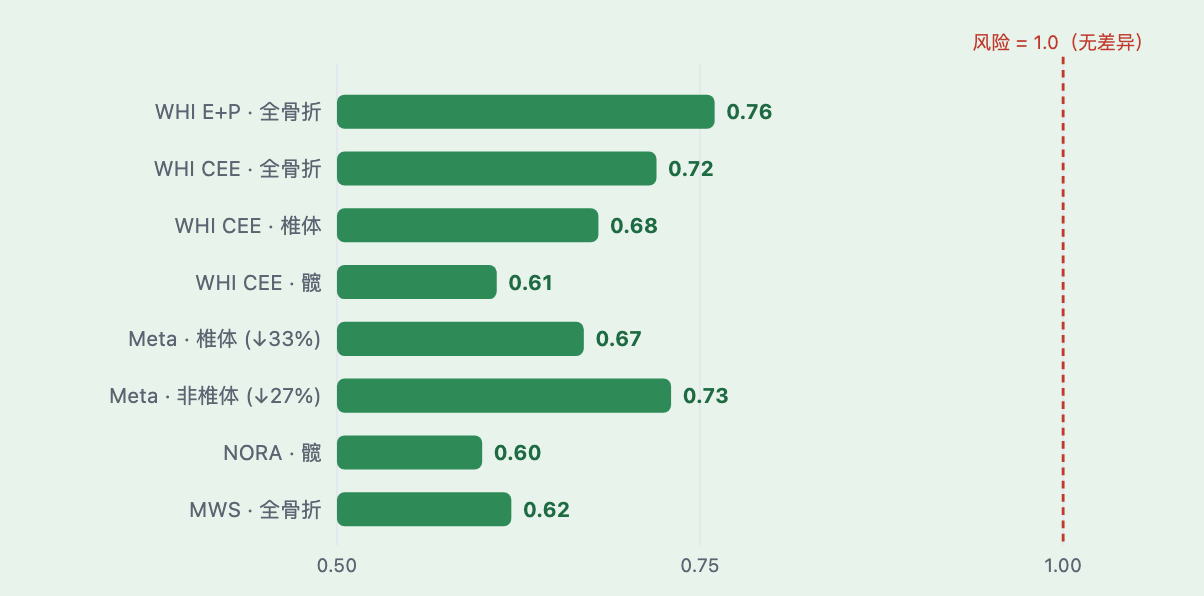
All values are < 1.0, indicating lower risk than among nonusers; shorter bars represent stronger protection. The vertical dashed line marks “1.0, no difference.” CEE alone shows the greatest hip-fracture reduction (HR 0.61), with corroborating real-world findings from NORA and MWS.
Four. Boundaries and consensus: what NAMS 2022 says, and who should or should not use treatment
Once evidence exists, the most demanding clinical task follows: translating it into “should this person use it, and how?” The North American Menopause Society (NAMS) 2022 position statement (Faubion et al., Menopause 2022;29(7):767-794) is one of the most authoritative references. It explicitly states that MHT remains the most effective treatment for vasomotor symptoms (VMS) and genitourinary syndrome of menopause (GSM), and can “prevent bone loss and fracture.”
1. The “timing hypothesis” and age window
NAMS 2022 emphasizes that MHT's benefit–risk ratio is most favorable for women <60 or <10 years since menopause. This “window” is not arbitrary: starting early, during accelerated bone loss, is more likely to restrain the loss curve, whereas delaying until age 60 and more than a decade after menopause raises cardiovascular and thrombotic concerns. Rather than debate “whether hormones should be used,” identify the patient “currently within the window” earlier and more accurately.
2. Route choice: transdermal and low dose
Bone protection mainly comes from estrogen itself, whereas venous thromboembolism (VTE) and ischemic stroke risks are substantially associated with the first-pass effect of “oral” administration. In line with multiple guidelines, NAMS 2022 recommends prioritizing transdermal (through the skin) estrogen or low-dose regimens when VTE is a concern or long-term bone protection is needed; these can significantly reduce VTE and stroke risks while retaining bone benefits. This is often underestimated in clinic: many patients reject all hormones because of “fear of clots,” without being told about “taking a different route.”
3. Special populations: early menopause and POI
For women with premature ovarian insufficiency (POI) or menopause before age 40, estrogen deficiency starts young and the bone account is “overdrawn early.” NAMS 2022 explicitly recommends MHT until the average age of natural menopause (about 51) to cover the bone and cardiovascular protection window. This is not “cosmetic supplementation,” but medical restoration for a defined pathological condition.
4. Relationship with osteoporosis medicines: complementary, not interchangeable
A clear boundary is essential here. MHT excels at “preventing loss, reducing risk, and preserving peak reserves” and is a preferred preventive option for most perimenopausal women. But when a patient already has a fragility fracture, DXA shows a T-score ≤-2.5, or FRAX estimates exceed high-risk fracture thresholds, MHT alone is often insufficient. According to osteoporosis guidelines, antiresorptive or bone-forming medicines such as bisphosphonates, denosumab, or teriparatide need to be added or substituted. These are “different units in the same battle,” rather than an either-or choice. Treating MHT as an “osteoporosis treatment drug” is one of the commonest clinical misconceptions.

Gothenburg City Theatre at night, Sweden | Photograph by
W.carter
,
CC BY-SA 4.0
.
Red-line boundaries (must be explained in person)
MHT is not recommended as sole therapy for established osteoporosis, particularly in someone who already has a fragility fracture; people with contraindications such as previous venous thrombosis, uncontrolled hypertension, active liver disease, or hormone-dependent cancer history should not start MHT “to protect bones.” Bone protection should instead focus on lifestyle and approved osteoporosis medicines.
5. DXA and FRAX: defining the boundary between “prevention” and “treatment”
“Do I actually need treatment?” is a common clinical question requiring tools, rather than intuition. Dual-energy X-ray absorptiometry (DXA) measures lumbar-spine and hip bone density, providing T-scores (relative to young peak values) and Z-scores (relative to age peers); FRAX incorporates age, BMI, previous fractures, parental hip-fracture history, smoking, glucocorticoid use, and other factors to estimate 10-year probabilities of major osteoporotic and hip fractures. A practical boundary is: T-score ≥ -1.0 is generally normal or low bone mass, managed mainly through lifestyle + MHT (if within the window) for prevention; T-score ≤ -2.5 or an existing fragility fracture enters the “treatment needed” range, warranting approved osteoporosis medicines. With those two reports on the desk, patients often immediately understand “why some people use hormones and others need injections.”
6. Bone loss after stopping: MHT's bone protection has an “active period”
A frequently asked but easily glossed-over clinical point is that MHT's bone-protective effect applies mainly “during treatment.” Follow-up studies show partial bone-mass decline within 1–3 years after stopping, with the loss rate returning toward the nonuser trajectory—as if “the manager has left and the cash machine starts running again.” MHT is thus not a one-off investment of “a few years' use for lifelong protection,” but more like insurance requiring ongoing payments. Before stopping or naturally transitioning beyond age 60, plan a “handover”: repeat DXA, assess FRAX, transition to osteoporosis medicines where appropriate, and maintain calcium, vitamin D, and exercise long term.

Nyhavn street scene, Copenhagen, Denmark | Photograph by
Jebulon
,
CC0
.
Three common clinical misconceptions
Misconception one: “Milk is enough; no need to consider hormones.”—Calcium supplies raw materials but cannot halt accelerated early postmenopausal resorption; the two are not mutually exclusive.
Misconception two: “Once I use MHT, I will never develop osteoporosis.”—MHT reduces risk without guaranteeing zero fractures; regular DXA follow-up is still needed.
Misconception three: “Hormones damage bones, so I should stop.”—Quite the opposite: within the appropriate window they protect bone, and abruptly stopping on your own removes that protection.
7. When MHT cannot be used: other routes to bone protection
Not every woman is suitable for MHT. With previous venous thrombosis, uncontrolled hypertension, active liver disease, hormone-dependent cancer, or similar circumstances, alternative bone-protection strategies should take over: approved medicines such as bisphosphonates, denosumab, and selective estrogen receptor modulators (SERMs) each suit different populations. Meanwhile, calcium, vitamin D, and weight-bearing exercise remain three “foundational medicines.” These options and MHT are parallel parts of a “toolkit,” rather than mutually invalidating choices. The clinical task is to find the best current balance of contraindications and benefits for the individual.
Five. Bringing evidence back to clinic: a reusable communication checklist
Even the best evidence only counts when it works in a 5-minute consultation. With this year's “for life” theme in mind, I divide routine clinical communication into three statements for colleagues:
First statement (building understanding): “Your bones are like a bank: you deposit before age 30 and withdraw after menopause. Estrogen is the manager helping you ‘withdraw less’; once it leaves, the cash machine starts running on its own.”—The “bone account” turns an abstract mechanism into everyday understanding.
Second statement (positioning MHT): “Hormones do not treat fractures. While you are within the window, they help your bones ‘hold back loss.’ They reduce future fracture risk, rather than turning already osteoporotic bones young again.”—Calibrate expectations first to avoid “Why was I diagnosed with osteoporosis even though I used hormones?”
Third statement (offering action): “Let's obtain a DXA and calculate FRAX, then see whether you are in ‘prevention’ or ‘already need treatment.’ Whether or not you use hormones, calcium, vitamin D, and weight-bearing exercise are all part of your plan.”—Return informed choice and shared decision-making to the patient, while retaining lifestyle as the foundational prescription.
An additional point for clinician readers: World Osteoporosis Day's value is not just a day of education, but reminding us to build the habit of “follow up every fragility fracture.” A wrist fracture or vertebral compression fracture is often a “yellow light” for the whole skeleton. Bringing FLS thinking into everyday practice can change a woman's later-life bone outlook more than any single prescription.
A final note on “follow-up rhythm”: after starting MHT for bone protection, monthly reassessment is unnecessary. A review of bone density, symptoms, and tolerability is usually recommended at 1 year, then every 2–3 years as appropriate; new back pain, significant height loss, or signs of a new fragility fracture warrant an earlier review at any time. Writing “follow-up” into the prescription completes the care loop—the most straightforward practical expression of this year's “for life” theme.

Kirkjufell in winter, Iceland | Photograph by
Beardhatcode
,
CC0
.
Six. Lifestyle prescription: three “foundational medicines” that always belong in the plan
Whether or not MHT is ultimately used, three prescriptions belong in every consultation. First, calcium: total dietary intake plus supplementation is generally suggested at around 1000–1200 mg daily (food first, supplements for shortfalls); individual supplement doses should not exceed 500–600 mg for absorption, and should be separated from certain medicines such as levothyroxine. Second, vitamin D: aim to maintain sufficient serum 25(OH)D, individualizing dose by deficiency and sun exposure; food and sunlight alone are often insufficient among women in China. Third, weight-bearing and resistance exercise: brisk walking, jogging, tai chi, dumbbells, and similar activities use mechanical stress to tell bones “this needs to be stronger.” They do not replace medicines, but support maximal benefit from any medicine. Calling these “foundational medicines” is a reminder that they are not MHT's backup options, but the foundation of bone protection “for life.” Recent research also emphasizes protein intake for the muscle–bone axis: adequate high-quality protein underpins muscle mass, which itself cushions bone density—a factor often underestimated in fall prevention and fracture reduction.
Quick-reference reading table for clinicians
| Reference | Year/source | Points relevant to this article |
|---|---|---|
| Cauley JA et al. Estrogen plus progestin and fracture risk | 2003, JAMA (PMID 14519707) | WHI E+P, n=16,608; all-fracture HR 0.76, hip BMD +3.7% |
| WHI CEE-alone fracture subgroup | 2003–2004, JAMA | All-fracture HR 0.72, hip HR 0.61, vertebral HR 0.68 |
| 1973–2000 RCT meta-analysis | Systematic review | Vertebral fractures ↓33%, nonvertebral ↓27% |
| NORA (National Osteoporosis Risk Assessment) | Cohort study | Hip-fracture OR 0.60 among current MHT users |
| Million Women Study | UK cohort | All-fracture RR 0.62 among current users |
| Faubion SA et al. NAMS 2022 Position Statement | 2022, Menopause 29(7):767-794 | HT prevents bone loss and fractures; favorable benefit–risk ratio at <60/<10 years since menopause; transdermal/low dose reduces VTE and stroke; POI treatment until average menopause age; may continue beyond 65 for osteoporosis prevention |
| IOF World Osteoporosis Day 2026 | 2026 theme | “Build, Protect, Strengthen Bones — for life”; about 500 million affected globally, approximately 70 fractures/minute at >55, 1/3 of women 50+ will fracture, 80% of fragility fractures lack follow-up |
The takeaway in one sentence
MHT is a powerful tool to help bones “hold back loss and preserve capital” within the menopause window, but it is not an osteoporosis treatment drug and cannot replace antiresorptive therapy—true bone protection begins with informed choice and takes shape through a DXA, a FRAX assessment, and the decision you make together with your clinician.
This article is for education and professional reference, not individualized medical advice. Decisions about starting or adjusting MHT and preventing or treating osteoporosis should reflect individual circumstances, local guidelines, and shared decision-making with the treating clinician. International research cited here has population and design boundaries (mostly European and North American populations, with some observational evidence), requiring caution when extrapolating to Chinese women.
Sources: IOF World Osteoporosis Day 2026; WHI (Cauley et al., JAMA 2003); NORA; Million Women Study; 1973–2000 RCT meta-analysis; NAMS 2022 Position Statement (Menopause 2022;29(7):767-794).
Read the source material
- The 2022 NAMS hormone therapy position statement
- Cauley et al.: WHI estrogen plus progestin and fracture risk
- NIAMS: Osteoporosis
The original archive manuscript is restored above. These additional references offer context; their inclusion does not constitute medical validation of every original claim. Clinical and regional terminology review are pending.
A good question starts a conversation.
Explore a related editorial discussion. Reading is open to everyone; posting and replying require a free reader account.
More from the library
 Hormones & treatment · 10 MIN READCan You Use MHT With High Cardiovascular Risk? Reading a Position Paper and a New Study↗
 Hormones & treatment · 14 MIN READSo Many Estrogens: What Actually Makes Them Different?↗
 Hormones & treatment · 6 MIN READUK BMS / NICE 2026 Menopause Practice Update: Seven Key Changes, With Theory and Evidence Explained↗