Reading Estrogen Matters: Arguments, Evidence Tools, and Remaining Disagreements
A reading exercise prompted by the source essay on Estrogen Matters: examine stance, study populations and absolute risk without turning an argument into a prescription.

In this article
Original book
Estrogen Matters: Why Taking Hormones in Menopause Can Improve and Lengthen Women's Lives — Without Raising the Risk of Breast Cancer
Authors
Publication
Revised and updated 2024 edition, 336 pages
Edition note
Contents of the 2024 revised edition
Chinese edition
No simplified-Chinese edition located
Report date
Opening: placing this book in context
Estrogen Matters is not a clinical review that can replace a guideline. It is an explicitly argued brief for a position. It asks why, after WHI, the public rapidly came to understand hormone therapy as carcinogenic, harmful to the heart, and without benefit.
This report follows the book’s arguments about WHI, relative risk, and progestogens, then separately lists opposing evidence insufficiently addressed by the authors. Borrow its questions without treating its judgments as a personal prescription.
Three boundaries first:
- A book’s position is not independent consensus. Chapter attribution does not mean every figure has been checked page by page.
- WHI’s limitations do not make all its results wrong. Populations, regimens, and initiation timing differ, so conclusions cannot substitute for one another.
- Estrogen is not a complete regimen. Preparation, dose, route, progestogens, and personal history change the benefit–risk discussion.
0. An honest statement about this report’s citations
This report is not a page-by-page reading. I did not obtain the full text: no lawful electronic version was available, and the user’s knowledge base did not contain it. I therefore cannot give exact pages for specific quotations.
References use two markers:
| Marker | Meaning | Reliability |
|---|---|---|
| [Chapter located] | Argument located by chapter; titles from a library’s complete 2024 contents record, without starting pages | High for attribution, exact pages unverified |
| [Source unverified] | Figures/statements from Science-Based Medicine’s review including ten WHI criticisms; Shortform, Bookey, MinuteReads summaries; Jeffrey Dach MD; publisher/library descriptions | Moderate; agreement across summaries helps, but book pages remain unverified |
Anything without a verified page is marked; pages are never invented.
Numbering differs between the 2018 original and 2024 revision. This report uses 2024 names. Dach’s 2018 review concerns the original; relevant distinctions are identified.
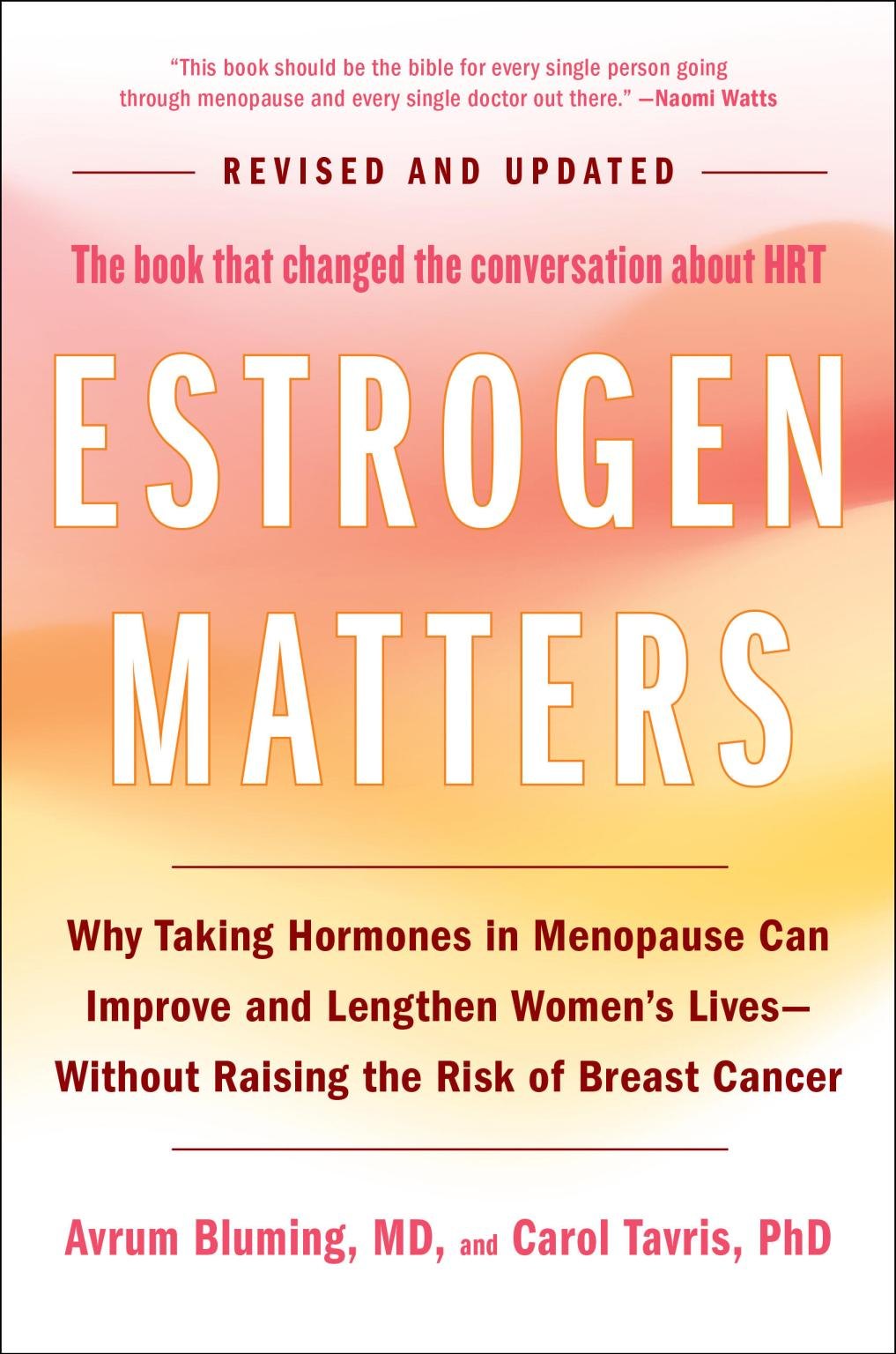
Cover of the 2024 revised Estrogen Matters
I. The dispute: reinterpreting WHI
The opening question is pointed:
Introduction: Who killed hormone therapy?
The question is why public discussion rapidly classified menopausal hormone therapy as dangerous. The authors blame trial design, release, interpretation, a prepublication press conference, and media amplification of relative risk, rather than data alone.
Its position can be condensed:
The post-WHI conclusion that estrogen causes cancer, harms the heart, and has no benefits may combine design, timing, and communication issues. Benefits in appropriate populations/regimens may have been underestimated, and risks should not be judged solely through early public accounts of WHI.
Its challenge concerns how a study becomes a public conclusion, rather than one number.
It revisits an established causal narrative. Mosconi reframes menopause as neurobiological rather than psychological; this book attempts to reexamine a conclusion embedded in textbooks, labels, and a generation’s choices.
II. The authors’ positions
Credibility begins with their combination of expertise.
Avrum Bluming, medical oncologist, USC Keck emeritus clinical professor, and former NCI senior investigator, has spent his career on the book’s counterintuitive subject: breast cancer treatment.
Carol Tavris, social psychologist and independent scholar, studies self-justification, cognitive dissonance, and pseudoscience’s social spread. Her book with Elliot Aronson, Mistakes Were Made (but not by me), examines defending mistaken beliefs.
Why does this combination matter?
Challenging twenty years of fear requires two tasks:
- Show medical evidence was misread, requiring oncology.
- Explain why the interpretation persisted despite correction, requiring social psychology.
Many debate books do only the first, then wonder why facts fail. This attempts both.
A personal motivation readers should know
The conclusion is “Martha, medicine, and making decisions” [Chapter located | Conclusion]. Bluming’s wife Martha was diagnosed at 45. Treatment succeeded, but chemotherapy induced menopause and severe symptoms. Searching for relief led him into this literature and toward unexpected conclusions.
[Source unverified | Consistent MinuteReads and Bookey accounts]
This provides understanding and a reason for independent scrutiny. It gives warmth while showing a mission rather than a neutral-review role. His 2008 Journal of Clinical Oncology study concluded estrogen did not increase survivor recurrence; he recommended it to his daughter, herself a survivor [Source unverified | Dach review].
How to read this book
A brief
A systematic review
Canadian mountains and lake | No medical conclusion is conveyed by the photograph
III. Five analytical tools
Model one: causal proof—persistent inconsistency may challenge a hypothesis or methods
This is a particularly transferable methodological discussion.
Chapter 3 asks “Does estrogen cause breast cancer?” [Chapter located | Chapter 3].
The authors apply Bradford Hill’s considerations, a standard epidemiological framework, rather than immediately answering yes or no.
The nine considerations as applied in the book [Source unverified | Bookey and MinuteReads agree]:
| Hill consideration | The book’s assessment |
|---|---|
| Strength | Weak association |
| Consistency | Many studies show no significant increase; conflicting results |
| Specificity | Not met; most patients never used estrogen |
| Temporality | Exposure does not consistently precede disease |
| Dose response | Absent |
| Plausibility | Counterarguments, below |
| Coherence | Inconsistent with existing knowledge |
| Experimental evidence | Absent |
| Analogy | None |
A notable plausibility argument:
It was once a treatment for advanced breast cancer.
[Source unverified | MinuteReads explicitly includes it]
A temporality argument to examine:
It declines
Yet rises after menopause
[Source unverified | Same source]
Transferable principle:
Repeatedly asserted causation without a stable effect size may indicate a problematic hypothesis, rather than merely a need for more studies.
Ask: after thirty years, is the effect clearer or less clear? Persistent ambiguity suggests the causal account remains unsettled.
Limits:
- Hill’s considerations are heuristics, not a mechanical test. Meeting more does not prove causality, nor does failing one disprove it; Hill rejected rigid criteria.
- Absence of evidence is not evidence of absence. This is a major risk in the book’s reasoning, discussed below.
Model two: external validity—does the result transfer to another population?
The first asks whether causation exists; this asks whether a trial applies to my patient.
Science-Based Medicine lists ten criticisms of WHI, illustrating external-validity checks:
Ten WHI problems asserted in the book [Source unverified | Science-Based Medicine]:
| # | Criticism | Category |
|---|---|---|
| 1 | Released before most investigators saw drafts; some later criticized procedure | Procedure |
| 2 | Initial breast-cancer increase not statistically significant | Statistics |
| 3 | Unrepresentative mean age, 63 | Participants |
| 4 | Nearly half current/former smokers, over one-third treated hypertension, 70% overweight/obese | Participants |
| 5 | Nonsignificant rise in 2002, no rise in 2006, lower risk with estrogen alone | Statistics |
| 6 | Some findings from data mining rather than prespecified hypotheses | Statistics |
| 7 | Claims of no symptom relief despite not studying symptomatic women | Participants |
| 8 | Heart-risk conclusion changed with initiation within ten years of menopause | Timing |
| 9 | Stroke increase attributed to statistical handling and absent after independent reanalysis | Statistics |
| 10 | Some investigators expressed an agenda to show harm | Agenda |
Transferable principle: three questions plus one procedural question:
1. Who participated? Do age, illness, and baseline risk resemble my population?
2. What intervention? Are drug, dose, route, and combination the same?
3. When initiated? At what physiological/disease stage?

+ Who asks? Did investigators have an agenda?
These extend beyond medicine to any “research shows” claim.
Important limits:
- Limited external validity does not mean false findings. The book faces substantial opposition, discussed below.
- Agenda is a warning, not refutation. Treating motivation as disproof is the genetic fallacy. Item 10 warrants scrutiny, not dismissal.
- Items 3 and 4 belong together. Age 63 plus 70% overweight/obesity, one-third hypertension, nearly half smoking history identifies high cardiovascular risk, considerably different from a healthy 52-year-old.
Model three: anchor absolute risk—relative risk attracts fear; absolute risk supports decisions
WHI’s widely circulated “26% higher breast-cancer risk” transformed a generation’s choices.
The authors distinguish:
Relative risk
Absolute risk
About nine additional cases per 10,000 women per year
[Source unverified | Summify and Shortform agree]
A communication comparison places tobacco beside MHT [Source unverified | MinuteReads]:
| Smoking–lung cancer | MHT–breast cancer | |
|---|---|---|
| Exposure among cases | ~85% involve smokers | 11%–24% involve MHT users |
| Survival | Lung cancer 15% | Breast cancer 90%; localized disease, commonest at diagnosis, five-year survival 99% |
NCI biostatistician Robert Hoover is cited:
Try to falsify your own theory.
[Source unverified | MinuteReads]
Transferable principle:
A risk figure without its baseline manufactures fear.
Limits:
- Small absolute risk is not negligible. The affected person experiences an event, not 0.09%.
- The tool works both ways, correcting exaggeration or minimizing harm. Check whether contrary evidence is also given.
- Mosconi explains fear formation; Bluming uses decision calculation. Without a framework, the number becomes mere reassurance.
Model four: inaction is an intervention—limits of “first, do no harm”
This deserves particular reflection.
Primum non nocere, first do no harm, became a default reason against MHT after WHI: not prescribing at least avoids harm.
The authors propose:
primum certior fi, tunc mone
First understand, then advise.
[Source unverified | Explicit Science-Based Medicine quotation]
Their logic: the assumption that action has risks and inaction none fails when inaction causes established harm.
They list osteoporotic hip fractures, cardiovascular risk, cognition, and symptom-related loss of quality of life [Source unverified | Multiple summaries].
They also assert “lowest dose, shortest time” lacked scientific support, reporting that NAMS favored doses/formulations matched to age, menopause timing, risk, and need [Source unverified | Science-Based Medicine].
Transferable principle:
Conservative choices assume inaction is safer. Test the assumption.
Outside medicine too, waiting and maintaining the status quo are not risk-free; their risks may go uncounted.
Limits:
- The maxim can favor excessive prescribing. Evidence for inaction’s harm must match evidence for treatment’s harm, or it becomes sales rhetoric.
- Understanding before advising places responsibility on clinicians to interpret evidence, a frequent implementation failure the maxim cannot solve alone.
Model five: pharmacology rather than origin stories
This is useful when reading drug information and abstracts.
Part one: progesterone versus progestins
A relatively clear, clinically relevant distinction:
| Natural/micronized progesterone | Synthetic progestins, e.g. MPA | |
|---|---|---|
| Origin | Identical to ovarian progesterone | Chemically modified for patenting, not the same molecule |
| Neuroprotection | Mitochondrial support, counters glutamate toxicity | None; may offset estrogen protection |
| Cardiovascular | Enhances estrogen protection | Offsets estrogen benefit |
| Mood | Preserves estrogen serotonin effects | May block effects/worsen mood |
| Androgenicity | None | Acne, hair loss |
| Breast-cancer risk | RR 0.67, 95% CI 0.55–0.81 | Higher-risk reference |
[Source unverified | RR from independent meta-analysis cited in The Wellness By Design Project via Endocrine Reviews / JAMA Oncology; other comparisons in Science-Based Medicine and Shortform]
WHI used MPA, not natural progesterone. Breast-cancer findings mainly concerned estrogen plus MPA; estrogen alone showed lower rather than higher risk.
Part two: an internal tension
The book contains a contradiction:
- Chapter 2 dismisses bioidentical as marketing terminology.
- Chapter 8, “Progesterone and the pill” in 2024, has Bluming correct this: prescription hormones molecularly identical to endogenous ones.
[Source unverified | Dach identifies the contradiction in the 2018 edition, whose numbering differs]
The authors’ concerns do not fully coincide. Tavris distrusts natural-origin commercial narratives through social psychology/feminism; Bluming emphasizes molecular structure through oncology.
Transferable principle:
Judge an ingredient by molecular structure rather than its origin story.
This rejects opposite claims:
- ❌ Natural/bioidentical therefore safer: molecular behavior needs evidence.
- ❌ Synthetic therefore harmful: MPA’s properties concern MPA itself.
Limits:
- Structure is not everything. Route, dose, metabolism matter; transdermal treatment avoids hepatic first-pass effects and differs in thrombosis profile.
- Dydrogesterone is retroprogesterone, a stereoisomer not identical to endogenous progesterone. Bioavailability, receptor selectivity, and low androgenicity need specific evidence, not “natural-like” rhetoric.
- Commercial boundary: evaluations concern active ingredients, not products. Keep public discussion at that level.
IV. Persuasion: costs first, then risks
The sequence is a case study in persuasion:
Introduction: Who killed hormone therapy? └─ Frames responsibility ↓ Chapter 1: The change of life and quality of life └─ Establishes untreated costs ↓ Chapter 2: Does estrogen cause breast cancer? └─ Hill framework, methodological highlight ↓ Chapter 3: Can survivors take estrogen? └─ Hardest case ↓ Chapters 4–6: heart, bones, mind └─ Organ-based arguments ↓ Chapter 7: Progesterone and the pill └─ MPA is not progesterone, clinically useful ↓ Chapter 8: Debate and final lesson └─ Opponents and conclusion ↓ Martha, medicine, and making decisions └─ Returns to a person
Three communication lessons:
Establish costs before risks. Chapter 1 considers untreated losses first. Benefits must be present for comparison, or every risk feels unacceptable.
Choose the hardest case, here breast-cancer survivors, rather than easy examples. If the hardest case stands, others appear more plausible.
End with a person. Data support judgment; Martha explains why it matters. Reversing the order can feel coercive.
V. Opposing evidence and reservations
Praise alone would be unhelpful. The first concern particularly requires attention.
1. A formidable opponent: Ioannidis disagrees
Science-Based Medicine states:
Even John Ioannidis, known for criticizing industry-funded research and “Why Most Published Research Findings Are False,” considers the evidence identifying hormones as a breast-cancer risk factor robust and scientifically sound. He and Bluming agreed to disagree.
[Source unverified | Science-Based Medicine]
This matters: he is a leading critic of evidence, not a conservative spokesman. If he considers the evidence sound, overturning WHI’s breast-cancer conclusions is not consensus.
Insufficiently addressing this is a major cost of advocacy.
2. A 50% heart-risk reduction is not established
The book claims reductions up to 50%. Shortform’s editorial note challenges it:
Researchers found a much smaller reduction.
Nineteen randomized trials.
[Source unverified | Shortform]
Many purported benefits come from observational research unable to remove healthy-user bias. Early, consistent users with follow-up often have better literacy, resources, and access. The bias favors benefit and cannot be fully adjusted away.
Oncology researchers also challenged survivor mortality of 3% with MHT versus 11.4% without [Source unverified | Shortform counterpoint].
3. Insufficient progesterone discussion: criticism from opposite camps
Progesterone draws criticism from two opposing camps.
Functional/alternative medicine critics, including Dach, The Wellness By Design Project, and Healthy Gut Girl, argue:
- Progesterone is neglected while estrogen is treated as universally beneficial.
- Serum levels replace tissue-burden discussion.
- Reassurance overlooks metabolism, detoxification, and genetic differences.
These criticisms contain weakly evidenced concepts, such as estrogen dominance and detox pathways. The valid point is an estrogen-centered book, while clinical MHT requires estrogen/progestogen decisions together.
4. Perspectives remain juxtaposed
The contradiction reflects Tavris’s critical and Bluming’s evidence perspectives sitting alongside rather than fully integrating.
Tavris asks how fear persists, requiring suspicion of commercial stories. Bluming asks what molecules determine.
A tension remains between distrusting natural claims and recognizing structural advantages for some so-called natural products. Adjacent chapters do not resolve it.
5. Commitment requires independent checking
Martha, the 2008 study, and his daughter’s treatment give warmth without neutrality.
Use it by following references and tools independently, not directly repeating conclusions.
VI. Appropriate use
✅ Useful
| Tool | Use |
|---|---|
| Nine Hill considerations | Test X-causes-Y claims |
| Four external-validity questions | Participants, intervention, timing, agenda |
| Ten WHI criticisms | Potential evidence-limit checklist |
| Relative-to-absolute risk and tobacco comparison | Risk communication |
| MPA/progesterone distinction | Ingredient-level discussion |
❌ Not justified
- Do not cite it as systematic review. Its advocacy conclusions are contested.
- Do not repeat 50% heart-risk reduction, challenged by 19 RCTs.
- Do not infer prevention of cardiovascular disease/dementia, contrary to mainstream guidance and Mosconi’s caution.
- Do not generalize safety to survivors, its most disputed proposition.
A practical judgment
MPA versus progesterone/dydrogesterone distinctions, together with lower risk in estrogen-only WHI, contribute to evidence behind modern natural/natural-like progestogen preferences.
Keep the boundary: these assess ingredients/routes, transdermal estradiol plus non-MPA versus oral conjugated estrogen plus MPA, not products. Public discussion should stay there.
VII. Numbers and missing verification
| Item | Value | Reliability |
|---|---|---|
| WHI relative increase | 26%, described as nonsignificant | [Source unverified], multiple summaries |
| Absolute increase | ~9/10,000/year, <1% | Summify/Shortform, unverified |
| Mean age | 63 | Multiple, unverified |
| Overweight/obese | 70% | Science-Based Medicine, unverified |
| Current/former smoking | Nearly 50% | Same |
| Treated hypertension | Over one-third | Same |
| Progesterone versus progestins | RR 0.67, 95% CI 0.55–0.81 | Independent meta-analysis cited via Endocrine Reviews / JAMA Oncology, unverified |
| Book’s heart reduction | Up to 50% | ⚠️ Challenged by 19 RCTs |
| Survivor mortality | 3% versus 11.4% | ⚠️ Challenged by oncology researchers |
| MHT among cases | 11%–24% | MinuteReads, unverified |
| Localized five-year survival | 99% | Same |
| 2024 length/references | 336 pages / pp.263–319 | Library record, chapter located |
VIII. Six statements
- Who killed hormone therapy?, introduction [Chapter located].
- Try to falsify, not merely confirm theories, attributed to Robert Hoover [Source unverified].
- Estrogen once treated advanced breast cancer, with the authors’ argument that a cause could not also treat it [Source unverified | chapter 2].
- Claims of no symptom relief without symptomatic participants [Source unverified | criticism 7].
- First understand, then advise, primum certior fi, tunc mone, instead of first do no harm [Source unverified].
- Lowest dose, shortest time never had scientific support, as asserted in the book.
IX. Further reading: return to primary research
- Jen Gunter, The Menopause Manifesto: another defense, sharper rhetoric; compare argument and communication.
- Lisa Mosconi’s menopause book: same WHI history through the brain rather than evidence criticism.
- Primary material: WHI long follow-up and current NAMS statements. Do not decide through any book’s retelling alone.
- Tavris/Aronson, Mistakes Were Made (but not by me): theory behind persistent fear and self-justification.
X. Return conclusions to evidence
The contribution is not a blanket claim that MHT is safe. The dispute remains, with Ioannidis an opponent who cannot be casually dismissed.
It offers an evidence-analysis toolkit.
Tools do not require acceptance of conclusions.
That makes it worth reading even when disagreeing.
Bluming’s response is illustrative: he and Ioannidis agreed to disagree rather than simply declaring the other wrong. A mission-driven author acknowledging the central disagreement shows restraint more persuasive than any isolated number.
“Matters” means estrogen is important and that the issue demands care. The second meaning matters most: how we decide what matters is itself essential.
End of report | No Chinese edition located; verify quotations/pages against the English original
Read the source material
- NCI: Menopausal hormone therapy and cancer
- NICE: Menopause identification and management NG23
- ACOG: Compounded bioidentical menopausal hormone therapy
The original archive manuscript is restored above. These additional references offer context; their inclusion does not constitute medical validation of every original claim. Clinical and regional terminology review are pending.
A good question starts a conversation.
Explore a related editorial discussion. Reading is open to everyone; posting and replying require a free reader account.
More from the library
 Reading & culture · 18 MIN READBody Literacy Without Shame: Reading Sheila de Liz Against the Evidence↗
 Reading & culture · 14 MIN READReading The New Perimenopause: Rediscovering Your Body in the “Zone of Chaos”↗
 Reading & culture · 15 MIN READReading The New Menopause: When Menopause Is No Longer Something to “Just Endure”↗